Showing posts with label blogathon. Show all posts

Sunday, February 18, 2018

Howard Cosell - Black Hat in the Booth

If you are searching for a villain in the world of sports TV broadcasting, one figure jumps quickly to mind. That would be the man who wrote the following in his 1973 self-titled autobiography:
Arrogant, pompous, obnoxious, vain, cruel, verbose, a show-off. I have been called all of these. Of course, I am.
The writer was none other than Howard Cosell.

When ABC launched the Monday Night Football package in 1970, executive producer Roone Arledge unveiled a unique three-man booth. Arledge inserted Cosell into the mix to supplement the traditional roles of a play-by-announcer (Keith Jackson) and analyst (Don Meredith). And the pivotal member of that commentary team was clearly Cosell.

Meredith, who was new to broadcasting, was so apprehensive as the season opener approached that he considered backing out of his contract to call the games. Cosell told Meredith: You'll wear the white hat, I'll wear the black hat. By casting himself in such a role and exhibiting all of the characteristics he outlined in the above book quote, Cosell turned Meredith into a hero to viewers who loved the way that Dandy Don would needle Humble Howard. Ratings surged as fans were drawn to the weekly banter between Meredith and Cosell. Meredith even earned an Emmy Award from that first season.

After the first game, Cosell became a villain in the minds of advertisers, most notably Henry Ford II of the Ford Motor Company who felt that Cosell detracted from his enjoyment of the telecast. He threatened to withdraw the Ford sponsorship of the prime time series unless ABC removed Cosell from the booth. After early season ratings proved stronger than expected, Ford backed off from the threat and Cosell remained a prominent member of the ABC NFL package for its first 14 years.

A key feature of this prime-time series was the halftime highlights segment which was narrated by Cosell. ABC would show select plays from subset of the Sunday games using NFL Films footage. Here, Cosell became the villain to many fans who would blame him if their favorite team wasn't shown on the highlight package. A bar in Denver actually conducted a weekly drawing with the winner getting to throw a brick at an old black & white TV when Cosell appeared on the screen.

Cosell always seemed to relish his role as the announcer that viewers loved to hate. He took the same approach in the way he portrayed himself in movies and guest appearances on sitcoms such as The Odd Couple.

In 1978, TV Guide conducted a survey to determine which TV sports announcers were the most liked and least liked by viewers. Cosell famously finished first in both categories! Of course, in the polling for least liked, the margin was overwhelming.

Cosell surfaced as a prominent villain in other sports as well. ABC acquired Major League Baseball rights in 1976, but suffered disappointing ratings for its first season of Monday Night Baseball and received poor reviews for its initial lead announcer team. As the postseason approached, the network performed a major overhaul of its broadcasters and unveiled plans to install Cosell for the ALCS. MLB commissioner Bowie Kuhn strongly objected because of comments by Cosell in recent years about how dull baseball had become. But Arledge held the trump card as the contract he had signed with MLB gave ABC the final say over announcers. So Cosell worked the playoffs and became a regular member of Monday Night Baseball the next season.

When ABC first bid for the TV rights to the 1976 Summer Olympics, the Montreal Olympic Committee tried to make the bid conditional on ABC not using Cosell on the telecasts. Again, Arledge won out as ABC got the rights and Cosell was ringside at the boxing venue.

Cosell called most of the key boxing matches on ABC during the 1970s. In 1982, he was at the mic for the Larry Holmes title fight against Randall "Tex" Cobb. The bout was extremely one-sided and Cosell, via his on-air commentary, implored the referee to stop the fight and expressed disgust that the match was allowed to go the distance.

Soon afterwards, Cosell declared that he was done with professional boxing and called for its abolition. Of course, he was lambasted by many in the press who viewed his stance as hypocritical since boxing was the sport where he first rose to prominence in the 1960s. He never worked another pro fight (although he did call amateur bouts during the 1984 Olympics).

Being a villain to the print media was nothing new for Cosell. He had a longstanding feud with sportswriter Dick Young of the New York Daily News who frequently attacked Cosell in his columns. He was also harshly criticized by Sports Illustrated for an interview he conducted with USA track coach Stan Wright during the 1972 Munich Olympics after a time schedule foulup caused two top USA sprinters to be disqualified.

In 1983, Cosell became a villain to the press once again when he used the phrase "little monkey" while praising Redskins wide receiver Alvin Garrett during a MNF telecast - which some perceived as racist. Later in that game, Cosell made the situation worse by issuing an on-air denial that he had used such a term. Despite the fact that Cosell had been a longtime supporter of civil rights, he was the subject of countless negative newspaper headlines over this incident.

Cosell was notorious for consuming alcohol before and during his telecasts. He famously left a Monday Night Football  telecast mid-game in Philadephia in 1970 after being drunk on the air and vomiting on Meredith's boots. His heavy drinking during the 1984 baseball playoffs also caused a major rift with Al Michaels.

Cosell became the villain yet again, this time to his entire industry, with the publication of I Never Played The Game in 1985. In the book, he blasted several of his former TV colleagues including Frank Gifford, OJ Simpson, and Meredith. Less than two weeks before the start of the 1985 World Series, ABC removed Cosell from its planned Fall Classic telecast team.

Also, in that book, Cosell wrote that in 1984, he received a call from Vince McMahon, chairman of the World Wrestling Federation. It turned out that McMahon wanted to hire Cosell to be the primary announcer for WWF wrestling telecasts. Cosell turned him down, but I find it intriguing to envision Cosell (the ultimate villain announcer) calling staged matches for McMahon's company at a time when professional wrestling was about to boom in popularity. McMahon went on to successfully feature many villain announcers of his own such as Bobby "The Brain" Heenan and Jesse "The Body" Ventura.

Howard Cosell was an absolute giant in the sportscasting industry. He dominated virtually any telecast in which he appeared and had the ability to elevate the perceived importance of each event. But, throughout his career, Cosell was seen as a villain by numerous entities - viewers, advertisers, league commissioners, sportswriters, and broadcasting colleagues - a true black hat in the booth.

This post is part of a Classic TV Villain Blogathon hosted by Classic Film and TV Cafe. Please check out the complete schedule of blog posts for this event.

Monday, March 7, 2016

The unique Al McGuire - from TV sidekick to star

The TV career of Al McGuire got its start on an event he wasn't even broadcasting. During the final seconds of the 1977 NCAA Tournament championship game with the outcome no longer in doubt, the NBC cameras zoomed in on the Marquette head coach. Earlier, McGuire had announced he would retire from coaching after the season at the relatively young age of 48. Curt Gowdy describes the scene as McGuire, on the verge of an unexpected championship, is overcome by emotion.


In rewatching this clip, I was struck by two things: 1) how McGuire (unintentionally) dominated the end of the telecast and 2) the prophetic quote from Gowdy at the 17:46 mark accompanied by a prophetic split screen image with a circle around McGuire (more on that later):
And McGuire who says: "I'm an entertainer. I entertain the fans."
and then this starting at 18:25 from Dick Enberg:
It's going to be sad for us to say goodbye to Al McGuire... Thank you Al McGuire... for the many great moments you've given us.
In fact, the college basketball TV entertainment factor was about to be ratcheted up several notches. The goodbye would be brief and even greater moments were on the horizon.


When McGuire retired from coaching, college basketball was a essentially a regional TV sport with just one national telecast per week. Just two seasons earlier, NBC had added the first regular season national network TV package with Enberg and Billy Packer as the announcers.

For the 1977-78 season, NBC hired McGuire who was a novice to television and added him to the mix. However, rather than place him courtside with Enberg and Packer, NBC initially stationed McGuire next to a monitor away from the court and only cut to him periodically during the telecasts (starting him off as the ultimate sidekick!). And NBC would place his image on a small corner of a split screen during his in-game commentary. After a few weeks of this awkward arrangement, Enberg and Packer convinced NBC to move McGuire alongside them to form a true 3-man broadcasting team.

Nothing about Al McGuire was scripted. Rather than attempt to fill the role of a traditional basketball analyst, McGuire simply "played" himself on the air. And, just as importantly, NBC allowed the true personality of McGuire to shine instead of trying to make him conform to a more conventional style.

He spoke sparingly at the beginning and his vocal delivery wasn't always smooth. But he had a feel for basketball and he eventually developed a feel for broadcasting. He described things in simple terms and offered opinions on in-game coaching decisions he would make. His unassuming style began to resonate with fans.

Al McGuire, Dick Enberg, Billy Packer
When he was a head coach, McGuire didn't watch film of opponents and left the strategic advance planning to his assistants. He made his imprint during games when he reacted to the situation at hand and made the appropriate adjustments. As a broadcaster, he took a similar approach. He didn't study rosters or statistics before telecasts. Instead he would ask a coach or scout to fill him in on a few key players for each team. When the TV lights came on, he would rely on his instincts for the game. He let the action on the court guide his commentary.

McGuire's distinctive voice, with his Brooklyn accent, just sounded so cool and drew me in. He brought a lot of colorful terminology to the airwaves: a tall player was an aircraft carrier, a down to the wire game was a white knuckler, a fancy move was French pastry, the lane area was the paint, and when a game was clinched, it was tap city. His style was enthusiastic and his commentary provided insight into his unusual coaching mindset.

As a coach, McGuire was unconventional to the core. In 1970, he turned down an NCAA Tournament bid and instead took Marquette to the NIT. (The NCAA no longer allows this.) He received two technical fouls in the 1974 NCAA championship game and blamed himself for costing his team a chance to win. He recruited many inner-city players from disadvantaged backgrounds. He implemented a "senior star" system in an attempt to get his veteran players noticed by professional scouts. He helped pioneer some stylish basketball uniform designs which were later banned by the NCAA.

Away from the arena, he loved to talk about motorcycles rather than basketball. Even though he earned decent money, he drew great pleasure from negotiating prices at flea markets. He was brilliant at reading people and relating to them. And he brought those traits into the broadcast booth.

A 3-man announcing team was very uncommon at the time, especially in the fast-paced game of basketball. But because co-analysts Packer and McGuire had such contrasting styles, it clicked. Enberg was emerging as one of the best play-by-play announcers ever. Packer followed the sport intensely (covering ACC games during the week) and focused on player matchups and strategy. McGuire added emotion and flair - the entertainment angle. The trio developed tremendous chemistry and meshed so well together. The resulting blend showcased the strengths of each.

Packer and McGuire frequently disagreed on the air which brought even more attention to the telecasts. The tandem would argue about everything from goaltending calls to coaching decisions to whether the undefeated Indiana State team deserved to be ranked #1 in 1979. Al would often playfully needle Packer about the ACC.

Because NBC generally covered just one national game a week, it was a huge event when the network came to town for a featured Sunday afternoon telecast. And McGuire, the former isolated sidekick, was quickly becoming the star of the show.

I recall tuning in and wondering what McGuire would say about Ralph Sampson or Bob Knight. Or what wacky predictions Al might make. When I played rec basketball in college, I remember McGuire's catch-phrases making their way into the action. When we watched the TV games, the banter between Packer and McGuire was a huge topic of conversation.

The Enberg/Packer/McGuire run lasted only four seasons. CBS acquired rights to the NCAA Tournament starting in 1982 and lured Packer away from NBC. McGuire continued to work regular season games with Enberg on NBC for several years before moving to CBS himself in 1992 and getting to call March Madness games again. After hiring Enberg in 2000, CBS did reunite the trio for one game that season. But McGuire only called two games after that and health issues forced him to miss the 2000 NCAA Tournament.

McGuire sadly passed away in 2001 from leukemia at age 72. But his legendary storytelling lives on, partly due to a one-man play written by Enberg titled McGuire and performed by actor Cotter Smith.

McGuire was elected to the Naismith Memorial Basketball Hall of Fame in 1992 as his charismatic TV color commentary supplemented his relatively short coaching career.

The following clip of McGuire on himself (at the 12:00 mark) captures the essence of McGuire:


For college basketball, Enberg is arguably the best play-by-play announcer of all time and Packer is arguably the best analyst ever. And yet they peaked during those four special seasons alongside McGuire when they formed my favorite all-time broadcasting team. Here is the classic trio on the call of a game from 1980:


College basketball on TV exploded in popularity starting in the late 1970s and I believe that McGuire was a key factor in that growth. By the late 1980s, the sport had national telecasts on all three major networks plus ESPN. But Enberg, Packer, and McGuire paved the way.

Al McGuire was indeed an entertainer and unique as a TV analyst. I thank him for all the great moments he provided.


This post is part of a TV Sidekick Blogathon hosted by Classic Film and TV Cafe. Please check out the complete schedule of blog posts for this event.

Tuesday, February 24, 2015

A look at the innovative Hill Street Blues

In January 1981, Hill Street Blues debuted on NBC and quickly became college dorm appointment viewing among my circle of friends. Set in an unnamed large city, the series focused on the police squad of the Hill Street precinct. Despite poor ratings the first season, the series received positive reviews, won several Emmy Awards and was renewed. It lasted for 146 episodes through May 1987. In 2014, the complete DVD set became available.

The style of Hill Street Blues was vastly different from the police shows of the time. The series used multiple storylines, several of which carried over to subsequent episodes. Many scenes featured background voices and other noises. Sometimes you had to really concentrate to follow the main dialogue though all the commotion. The show filmed action from non-traditional locations such as the men's bathroom at the station. Some scenes were dimly lit. Producers used many closeup shots from handheld cameras and often rapidly switched between camera angles. These techniques provided a more realistic feel, gave a sense of the chaos on inner city streets, and helped depict the dangers faced by the men and women in blue.

In contrast to a typical show of this genre which would focus on one lead detective and a sidekick, Hill Street Blues featured a large array of main characters. This opening credits sequence from 1985 showcases a whopping 16 names:


The innovative series was created by Steven Bochco and Michael Kozoll. In this interview, Bochco discusses various aspects of the show including the parallel storyline concept, casting decisions, and the pilot episode. He also talks about another iconic feature - the awesome piano theme music written by Mike Post.


Hill Street Blues covered topics such as police misconduct, racial tension, office politics, and ethical quandaries. The show also spotlighted the personal lives of the squad members and masterfully developed these characters over time. Many themes focused on personal demons - alcoholism, gambling, infidelity, depression.

Each episode would start in the morning and cover a single day. The show opened with the morning roll call which was conducted in the early seasons by Sergeant Phil Esterhaus (Michael Conrad). Esterhaus would speak in a distinctive slow-paced voice interspersed with eloquent language. He would always conclude with a version of his signature phrase "Let's be careful out there!".

Daniel J. Travanti played Captain Frank Furillo who exhibited a calm demeanor in dealing with each crisis that arose. A primary story line in season 1 was his intimate relationship (secret at the time) with public defender Joyce Davenport (Veronica Hamel). They formed an intriguing couple as their respective jobs sometimes pitted them as adversaries. Another interesting dynamic was how Frank was constantly juggling interruptions from his ex-wife Fay played by Barbara Bosson.

The show illuminated the bonds between regular police partners. I liked the chemistry of the Bobby Hill pairing with Andy Renko. Similarly, I was fond of the tandem of Joe Coffey and the strong female character Lucy Bates. Ironically, the initial pilot script called for Hill and Renko to die during a shooting, and the original intent was to kill off Coffey after a few episodes. Fortunately, plans changed allowing these excellent on-screen partnerships to flourish during the run. (Coffey was killed off during a shooting in season 6 and the impact on Bates was a key plot element).

Two of its actors had a major sports background. Mike Warren (who portrayed Hill) played basketball at UCLA and was a starting guard on the 1967 and 1968 national championship squads. Ed Marinaro (who played Coffey) was a running back at Cornell and finished second in the 1971 Heisman Trophy voting before playing parts of six seasons in the NFL.

Several episodes spotlighted the rather friendly working relationship between police officers and gangs. One aspect I found fascinating was the negotiations between police and gang leaders over terms such as turf boundaries. One gang leader was played by David Caruso who later served in the lead role in the Bochco series NYPD Blue. One episode featured a benefit basketball game between police and gang members which gave Warren a chance to show off his talent on the court.

The series used a lot of slang and pushed some boundaries with language - for example, many subtle sexual references and allusions to other bodily functions. The show also featured some quirky characters - most notably detective Mick Belker (who often referred to suspects as "Hairball" or "Dogbreath") and aggressive SWAT team leader Howard Hunter.

I'll timestamp a few things of note from this episode from the initial season:


  • 0:00 - morning roll call
  • 2:35 - scene in the station house men's room (involving Hunter of course)
  • 3:16 - a "Judas Priest!" exclamation from Hunter (and another at 4:25)
  • 6:30 - start of an action scene with dim lighting involving JD LaRue and Neal Washington
  • 10:00 - LaRue accepts a bribe
  • 12:14 - Henry Goldblume and Furillo negotiate with gang leaders (Caruso's character appears at 12:25)
  • 15:07 -  during a booking, Belker growls twice, types with one finger, and fields a phone call from his mother
  • 20:37 - Hill and Renko investigate a disturbance  
  • 26:34 - Furillo gets advice from Davenport
  • 30:10 - action scene with Hill and Renko
  • 35:05 - a demonstration of Furillo's leadership style
  • 38:40 - LaRue gets framed
  • 39:34 - Furillo/Davenport bubble bath scene
  • 42:40 - Frank deals with the latest situation involving Fay

Hill Street Blues was cleverly written and brilliantly casted. It was entertaining, educational, intense, and downright hilarious at times. Above all, it was riveting and drew me to subsequent Bochco series such as LA Law and NYPD Blue (and even the short-lived Bay City Blues).

This post is part of a Classic TV Detectives Blogathon hosted by the Classic TV Blog Association. Please check out the complete schedule of blog posts for this event.

Wednesday, June 4, 2014

The classic brilliance of Get Smart

On a recent trip to Washington, DC, I visited the International Spy Museum. The tremendous collection of artifacts housed there (such as this shoe with a heel transmitter used by the Romanian Secret Service) brought back memories of Get Smart, one of my favorite TV series of all time.

The classic spy spoof lasted for 138 episodes from September 1965 through May 1970. The first four seasons aired on NBC on Saturday night while CBS carried the final season on Friday night. The show then experienced a lengthy run in syndication. The Get Smart pilot was filmed in black & white, but all subsequent episodes were in color.

Mel Brooks and Buck Henry created the TV series which parodied the James Bond movies. The sitcom was set in the nation's capital and featured a trio of lead characters who worked for a secret espionage organization known as CONTROL.

Don Adams starred as Maxwell Smart - CONTROL Agent 86. Adams was brilliant in the role of a clumsy, dimwitted, and seemingly incompetent spy. Despite his numerous flaws, Smart was considered the top agent for CONTROL. Adams had a very distinctive vocal delivery which was ideal for playing Agent 86. He had previously been the voice of penguin Tennessee Tuxedo in a Saturday morning cartoon series. Adams was a former comedian and many of the Maxwell Smart antics and the classic "Would you believe?" sequences actually originated from his old stand-up routines. His mannerisms and wealth of one-liners put a stamp on Get Smart.

Barbara Feldon portrayed CONTROL Agent 99. Her character was never identified on the series by name and simply went by the moniker "99". In stark contrast to the bumbling Max, Agent 99 demonstrated intelligence, poise, and style. Feldon's low-key demeanor was perfectly suited for that role. During scenes involving Max and 99, Feldon would often lean or slouch to avoid drawing attention to the fact that she was taller than Adams. Her character married Max during season 4 and gave birth to twins in season 5. In the 1960s, it was rather rare to see a lead "career woman" on a TV series. According to Feldon, many female fans told her that they viewed Agent 99 as a role model.

Edward Platt played the Chief of CONTROL. No matter how badly Smart would bungle things, the Chief always trusted him with the most important assignments. Whenever Max made an inane remark, the stares and exasperated facial expressions by the Chief were priceless. Both the Chief and 99 were splendid in playing a "straight man" role to Max. The characters played by this trio on Get Smart were clearly the signature marks of their respective acting careers.

The show was memorable for the various spy gadgets used by the agents. On many episodes, Max and 99 would visit the CONTROL lab to obtain special weapons and equipment for their assignment. Max's apartment was also set up with various gizmos such as an invisible wall and a net which drops from the ceiling.

Obviously, the most famous gadget was Max's shoe phone which rings during the first scene of the pilot episode Mr. Big. Max would take off his shoe to make or receive a call with the Chief. Agent 99 used various phone gadgets including a comb and compact mirror. I find it fascinating to see the frequent usage of "mobile" phone devices on the 1960s Get Smart TV series in light of the modern cell phone.

My favorite gadget was the Cone of Silence. If the Chief was about to discuss top secret information, Max would claim that CONTROL regulations required them to use the Cone of Silence. The Cone was a clear plastic contraption which lowered from the ceiling of the Chief's office and covered their heads. As an aside, the name of the device seems curious as it was not in the shape of a cone. Of course the running gag was that the device never worked properly. The Chief and Max would have trouble hearing each other and would start yelling or leaning outside the Cone. Like the shoe phone, the Cone also debuted in the pilot episode. The writers creatively incorporated different failures of the Cone into various episodes. On one show, Max and the Chief resorted to using a set of cards called the CONTROL Secret Word File while still under the Cone. Another episode featured a portable Cone of Silence.

In a typical episode, the Chief would assign Smart and 99 to investigate and thwart a devious plan from KAOS, the so-called international organization of evil. The CONTROL agents would inevitably find themselves in a precarious position in the clutches of KAOS. Fortunately, some quick thinking by 99 or an occasional brilliant (or lucky) maneuver by Max would save the day for CONTROL - often assisted by the ineptitude of the KAOS agents.

The series featured a set of villains who made repeat performances. The most prominent of these was KAOS agent Siegfried who was played by Bernie Kopell using a thick German accent. The interplay between Smart and the recurring villains is classic as they seemed to treat each other as friendly rivals rather than arch enemies.

The plots incorporated other secret agents in minor roles. David Ketchum played CONTROL Agent 13 on several episodes where he would be stationed in a bizarre hiding location such as a vending machine, mailbox, garbage bin, ice machine, or airport locker.

An iconic feature of Get Smart was the show opening sequence and theme music. Max enters a building and walks down a hallway as an elaborate set of doors open and close until he enters a phone booth and then disappears from view. During the closing credits, he walks through the same doors in the opposite direction before the doors start closing in rapid fashion.

uu

The series featured many other legendary Maxwell Smart catchphrases:
  • "Sorry about that Chief"
  • "And loving it"
  • "Missed it by that much"
  • "The old < ... > trick"
  • "I hope I wasn't out of line with that crack about < ... >"
You could spend a few minutes on any random episode and recapture the magic of this series. I'll spotlight a few episodes which had somewhat of a sports theme and point out some examples of the catchphrases and classic scenes:

<UPDATE 12/31/14: I needed to refresh the video clips to embed from a different account, so the "bookmark" time stamps in the text may be off a bit.>

In The Last One In Is A Rotten Spy, Max has a cover assignment as an American swim team trainer. This episode contains an awesome scene from 0:45-4:00 where Smart unsuccessfully attempts to record a phone conversation and then searches for a pencil ("Two drawers and only one shot left"). It also features a memorable "Would You Believe?" sequence at 6:20. The scene starting at 7:40 demonstrates a classic Smart delay tactic which is capped off by the Chief screaming "Get in the pool!". There is a "Sorry about that Chief" at 10:16 and an example of  "And loving it" at 13:11.


I Shot 86 Today uses a golf course story line (and a double entendre title). At 8:20, Smart receives his special equipment from the lab complete with a golf shoe phone. Max predictably spikes himself in the face while using it at 17:30. Max spots "the old <mortar in the rocks on the 14th hole> trick" at 20:03. I get a kick out of the sidebar moment at 21:10 where a golfer patiently waits for the cart chase with gunfire to pass through before playing his stroke from the fairway.


While not a sports-related episode, A Spy for a Spy includes an epic scene at 18:22 where Smart and Siegfried negotiate trades of kidnapped CONTROL and KAOS agents like a pair of professional sports team general managers. Siegfried, who was making his first appearance on the series, utters what would become one of his classic recurring lines "We don't shush here" at 7:30. The banter between Smart and Siegfried highlights this episode, especially the weapon check scene starting at 8:00. This episode also contains an example of the phrase "I hope I wasn't out of line with that crack about <Fathead>" at 15:53.


Get Smart won a total of seven Emmy Awards including two for Outstanding Comedy Series. Adams received the Outstanding Actor in a Comedy Series honor three times while Feldon was among the nominees for Outstanding Actress twice.

This post is part of the Summer of MeTV Classic TV Blogathon hosted by the Classic TV Blog Association. Please check out the complete schedule of blog posts for this event.

Wednesday, July 17, 2013

The Odd Couple - and Big Mouth Howard Cosell

The classic TV series The Odd Couple is one of my favorite comedies. ABC televised it from September 1970 through March 1975. The network continually bounced the sitcom between Thursday and Friday nights using different time slots. The show received mediocre ratings during its original run of 114 episodes, but achieved much greater success during syndication.

The Odd Couple was set in New York City and starred Tony Randall as Felix Unger and Jack Klugman as Oscar Madison. Randall played a commercial photographer while Klugman portrayed a sports columnist for the fictional New York Herald newspaper. The TV show was based on a 1965 Broadway play of the same name written by Neil Simon. The initial season used a laugh track, but for subsequent seasons, the show was filmed before a live studio audience in Hollywood.

The two central characters were both divorced and shared a Manhattan apartment. Felix was quite meticulous, obsessed with cleanliness, and prone to sinus attacks. Oscar was rather sloppy and disheveled and would often wear a Mets hat backwards. Felix loved the opera while Oscar frequently gambled and smoked cigars. Randall and Klugman played their respective roles brilliantly. The duo had tremendous on-screen chemistry and the contrast between the opposite personalities of the characters worked perfectly. The episodes often featured sequences of rapid-fire dialogue filled with humorous one-liners. The banter between Felix and Oscar defined the show.

During some of the early seasons, the show used a variation of the following opening theme narration which ended with the classic question: "Can two divorced men share an apartment without driving each other crazy?"


Garry Marshall produced the TV series. The cast included two prominent supporting characters. One was Murray Greshler played by Al Molinaro. Murray was a policeman who was a regular in Felix and Oscar's poker game. The other was Myrna Turner played by Garry's sister Penny Marshall. Myrna was Oscar's secretary at the newspaper. Both Penny and Al would later surface on the sitcom Happy Days which Garry would also produce.

The Odd Couple utilized guest stars on several episodes. One of the most notable of these was Howard Cosell who was the most recognized sports announcer at the time. His Q score and notoriety were exploding as Monday Night Football on ABC grew in popularity. He also called many boxing matches and did segments for Wide World of Sports.

In a bit of ABC cross-promotion, Cosell made two appearances on the sitcom, both times portraying himself. As an aside, is there any TV personality in history more suited to playing himself/herself than Cosell? I would think not.

His first appearance came in a 1972 episode appropriately titled Big Mouth. In this show, Felix has landed a photography job for a cola advertisement spot featuring Cosell. The script contains several verbal clashes between Cosell and Oscar which played on the real-life disdain that Cosell and the New York Daily News sportswriter Dick Young demonstrated toward each other at that time.

The first part of the episode illustrates a typical exchange between Felix and Oscar. I especially like the way Felix exclaims "You took a cab to come here to borrow money?" As soon as Cosell enters, he and Oscar immediately start trading insults. Next, we have a super scene where Felix is ranting at Oscar who is at the typewriter working on a column which blasts Cosell. And note the way he "files" the article with Myrna.


The next clip includes a memorable "handshake" between Oscar and Cosell. Then there is the classic sinus and nasal twang routine resulting in Cosell calling Felix an "inane drone". Later, the script calls for Cosell to show off by rapidly rattling off the entire Colts defensive lineup from memory.


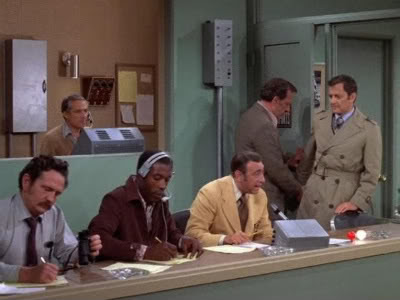
The final segment begins with Oscar learning that despite his request to pull the column, Myrna convinced the editor to run it. During the photo shoot, Cosell sees the article and storms out of the studio. In a broadcast scene, Cosell introduces Charlie - winner of the (classically titled) "Why I Want to Be Like Howard Cosell" contest. Cosell then tries to embarrass Oscar by putting him live on the air without warning. Oscar remains silent, overcome with stagefright, but Felix takes the microphone and jumps in with some elegant and longwinded play-by-play to bail out his best friend.

One more point of interest - According to a book by Mark Ribowsky, the lengthy departing remark from 8:09-8:36 mark on this clip was actually written by Cosell.


Cosell made a return appearance on The Odd Couple in the 1975 episode Your Mother Wears Army Boots. ABC executive producer Roone Arledge also played himself in that show as did opera singer Martina Arroyo. That episode also used the Monday Night Football angle with ABC hiring Oscar as a temporary fill-in for Alex Karras in the booth.

For a "non-actor", I feel that Cosell demonstrated rather impressive acting skills on these shows and added greatly to the entertainment. He sounded authentic with his distinctive and deliberate vocal pattern. The writers gave him many great lines, but Cosell was willing to play a caricature of himself and was quite successful in doing so. At various points in the 1972 show, Cosell describes himself as "the big man", "the great one", "the gifted one", "the single most identifiable voice in all broadcasting", and refers to "my own special talents". In the 1975 episode, he brazenly refers to Monday Night Football as "my show".

The production was surprisingly shoddy regarding the football games Cosell was broadcasting. The 1972 episode covers two Giants games and both times the displayed footage contains artificial turf. The show implies that the first game was in New York and specifically describes the second game as being at Yankee Stadium, but it had natural grass. The Giants didn't play home games on artificial turf until 1976. Charlie calls a play as ending at the 49-yard line, but the footage shows a tackle around the 30-yard line. On the play Felix calls, he describes Roger Staubach being stopped for no gain, but the footage shows Duane Thomas being tackled. In the 1975 episode, Cosell describes a 19-yard pass by Joe Namath, but the footage shows the play covering only 11 yards. Finally, both episodes portray Cosell as an NFL play-by-play announcer rather than the unique "third man in the booth" role he actually filled on the ABC games.

Other guest stars with sports ties who played themselves on this series included Deacon Jones, Bubba Smith, Bobby Riggs, and Billie Jean King. Some additional celebrities who did likewise: Bob Hope, Dick Clark, Betty White, Richard Dawson, Hugh Hefner, and Wolfman Jack along with game show hosts Allen Ludden (Password) and Monty Hall (Let's Make a Deal).

Randall and Klugman each had long and successful acting careers, but both were best known for their roles on The Odd Couple as evidenced by virtually any obituary or tribute written for either one. Klugman won the Emmy Award for Outstanding Lead Actor in a Comedy Series in both 1971 and 1973 for his role as Oscar while Randall took the same honor in 1975 for his role as Felix. During the entire 5-season run of the series, both Randall and Klugman were among the handful of nominees for this award every year.

In addition to the Me-TV networkThe Odd Couple is also currently available on the Cloo TV network and many clips from the series appear on Youtube.

This post is part of Me-TV's Summer of Classic TV Blogathon hosted by the Classic TV Blog Association. Go to http://classic-tv-blog-assoc.blogspot.com/ to view more posts in this blogathon. You can also go to http://metvnetwork.com/ to learn more about Me-TV and view its summer line-up of classic TV shows.

Thursday, July 11, 2013

Me-TV Summer of Classic TV blogathon

If you are a fan of classic TV, you will want to check out this blogathon which starts on Mon 7/15. The event is sponsored by the Classic TV Blog Association (CTVBA) of which I am a member. It will feature posts by several talented bloggers about various classic TV series which currently run on the Me-TV network.

I am participating with a post on The Odd Couple which will have somewhat of a sports angle and will appear on my blog on Wed 7/17.

Throughout the week, other blogs will cover classic TV shows such as:
  • Get Smart
  • The Mary Tyler Moore Show
  • My Three Sons
  • The Honeymooners
  • Dragnet
  • Bewitched
  • and many more 
Over 30 classic TV blogs are signed up to participate. See the complete blogathon schedule on the CTVBA site.