Showing posts with label Olympics. Show all posts

Wednesday, August 17, 2016

1972 Howard Cosell interview with USA Olympic track coach Stan Wright

One of the most riveting TV moments from the 1972 Summer Olympics was an interview conducted by Howard Cosell with USA track coach Stan Wright which ABC televised on 8/31/72. Cosell grilled Wright over the time schedule foulup resulting in USA sprinters Rey Robinson and Eddie Hart being disqualified for missing their 100m qualifying heats.

In 2012, ESPN Classic aired a series of specials looking back on the Munich Games. Here is the video of the USA track controversy episode and a summary of that show that I wrote at the time.


A quick guide to the Cosell portions of the clip:
  • 3:05 - interview with Robinson
  • 5:22 - interview with Hart
  • 10:41 - interview with Wright
  • 15:35 - Cosell follow-up commentary
  • 39:03 - interview with 400m medalists Wayne Matthews and Vince Collett regarding their controversial national anthem ceremony
The 9/11/72 edition of Sports Illustrated blasted Cosell for the Wright interview and his subsequent commentary. Wright threatened to sue the ABC sportscaster, but instead spoke out against Cosell during a news conference the following year.

While Wright is best remembered for this incident, he was inducted into the National Track and Field Hall of Fame in 1993. 

Tuesday, September 17, 2013

Daytime major network sports telecasts on weekdays

The typical timeslots for national sports telecasts on the major over-the-air networks are weekends, holidays, and prime time. It is relatively rare for TV networks to show daytime sports programming on weekdays when a sizable portion of the potential audience is at work or in school. But this does occur on occasion and here is a sport-by-sport historical summary of my research of such telecasts.

For the purposes of this post, I am only considering telecasts on the major networks (CBS, NBC, ABC, and Fox) and I am excluding major holidays.

MLB

From 1947-1970, all weekday World Series games were televised in the afternoon. NBC also aired two weekday afternoon games in 1971 sandwiched around the first prime time World Series telecast. The last weekday afternoon World Series telecast took place in 1972 when rain impacted the original weekday prime time schedule and NBC carried the rescheduled game 5 on a Friday afternoon.

Since 1969, most postseasons have featured at least one League Championship Series game on network TV on a weekday afternoon. The exceptions are:
  • 1975 (regional weeknight coverage in prime time)
  • 1994 (no postseason)
  • 1995 (regional weeknight coverage in prime time via the ill-fated Baseball Network)
  • 2002 and 2005 (both years, Fox would have televised a weekday afternoon game had one series not ended early) 
  • 2007 (all Fox LCS telecasts were at night)
The 1981 divisional playoff round also included some weekday afternoon network telecasts. And, in 2001, Fox televised three League Division Series games on weekday afternoons.

Major networks also provided weekday afternoon coverage of the tie-breaker series in 1951, 1959 and 1962 and tie-breaker games in 1978 and 1980.

From 1949-1966, every MLB All-Star game was televised on a weekday afternoon. The same was true of the 1969 game which was rescheduled on a Wednesday afternoon following a rainout the previous night.

College basketball

From 1991 to the present, CBS has presented afternoon coverage of the opening Thursday and Friday of the NCAA Tournament.

On Friday Dec 31 in 2010, CBS televised an afternoon regular season game.

College football

Starting with 1973, the major networks have provided one or more afternoon telecasts annually on "Black Friday" - the day after Thanksgiving. Also, during the bowl season, networks have often televised weekday afternoon games on dates such as Dec 31 and Jan 2.

NFL

For many years, the NFL avoided playing any games on Christmas Day. When the holiday fell on a Sunday, this policy resulted in Monday afternoon Dec 26 telecasts of the NFL Championship game on NBC in both 1955 and 1960. In 1977, CBS televised a divisional playoff doubleheader on Monday Dec 26. CBS also aired a wild-card playoff game on Monday Dec 26 in both 1983 and 1988.

CBS televised an afternoon regular season game on Friday Dec 31 in 1993. Fox provided afternoon telecasts on Friday Dec 24 in both 1999 and 2004.

Golf

Going back to 1996, NBC has annually televised 2 hours in the late afternoon of the Thursday and Friday rounds of the US Open.

CBS provided Friday afternoon coverage of the Masters in 1956 and 1957.

Major networks added Monday afternoon coverage of 18-hole playoffs for:
  • the Masters in 1962, 1966 and 1970
  • the US Open in 1965, 1966, 1971, 1975, 1984, 1988, 1990, 1991, 1994, 2001, and 2008
  • the PGA Championship in 1961 and 1967
and of Monday finishes due to rain for:
  • the Masters in 1961, 1973 and 1983
  • the US Open in 1983 and 2009
  • the British Open in 1988
  • the PGA Championship in 1976, 1986, and 2005
Tennis

For several years, CBS has televised Friday afternoon action during the second week of the US Open. Since 2008, CBS has also provided a late afternoon telecast of the men's finals on Monday. From 2008-2011, rain necessitated the Monday finish. Since 2012, the tournament has been scheduled to conclude on Monday.

Similarly, NBC has carried daytime weekday coverage for many years during the second week of the French Open tournament although much of that action has been on tape delay. NBC did the same for Wimbledon when it held the network TV rights.

NHL

NBC televised the 2012 Winter Classic on Monday afternoon Jan 2 as New Year's Day fell on a Sunday.

Auto racing

The 1997 Indianapolis 500 was postponed by rain on Sunday and suspended after 15 laps on Monday (Memorial Day). It was resumed on Tuesday May 27 and ABC provided a daytime telecast of the race.

Note: The 2012 Daytona 500 was postponed by rain on Sunday and Fox had planned to televised the rescheduled event on Monday Feb 27 at noon. However, additional rain caused the race to be pushed back to Monday night so the Fox telecast wound up in prime time.

Olympics
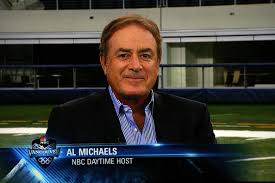

The major networks holding the rights have made a habit of devoting many daytime weekday hours to both the Summer and Winter Olympic games.

Summary

Several of these examples involve special circumstances such as rain postponements, tie-breakers, or events taking place on the day before/after a major holiday. The yearly staples which still wind up on "regular" daytime weekday TV are:
  • NCAA Tournament opening Thursday and Friday afternoon sessions
  • US Open golf Thursday and Friday rounds
  • some action from the second week of tennis majors
  • usually at least one game of the MLB LCS

Wednesday, April 3, 2013

Error in ESPN 30-for-30 short on 1972 Olympic basketball

I highly recommend the recent ESPN 30-for-30 digital short Silver Reunion which includes all 12 members of the 1972 USA Olympic Basketball team. The episode focuses on the continuing refusal by the players to accept silver medals after the controversial conclusion to the gold medal game. Unfortunately, this otherwise excellent documentary contains an inaccuracy.

At the 2:02 mark, the film displays a graphic which incorrectly states that the 1972 Olympic basketball games were played without a shot clock. Right after this, Doug Collins comments on the late game situation and perpetuates this myth which he has repeatedly done over the years.

The Olympics have always been played under international (FIBA) rules. FIBA introduced a 30-second shot clock in 1956 and that rule was indeed in effect for the 1972 games. The reason the USSR didn't try to run out the clock entirely on that possession was to avoid a shot clock violation. The 30-second clock also explains why the USA didn't attempt to foul a Soviet player as time was running out.

In September, Ken Pomeroy wrote an intriguing retrospective on 40th anniversary of this game where he also pointed out the shot clock rule, the faulty memory of Collins, and the staggering fact that announcers Frank Gifford and Bill Russell never once mentioned the shot clock during the entire ABC telecast. Perhaps that omission contributes as much to this longstanding myth as anything.


Monday, February 11, 2013

The NBC false claim - and opening night of 1980 Winter Olympics on ABC

NBC recently issued a press release claiming that its planned coverage of the 2014 Sochi Olympics would feature the first ever prime time event coverage before the opening ceremony. However, this NBC claim is false. In 1980, ABC opened its Winter Olympics coverage in prime time on Tues 2/12 from 9:30 - 11 pm ET, one night before the opening ceremony on Wed 2/13. (For completeness, ABC did the same thing in 1984 for the Sarajevo games.)

<Update 2/25/2013: ABC also provided prime time coverage the night before the opening ceremony in 1976 for the Innsbruck games (per a blog comment which I have verified).>

I watched the Olympics on ABC that opening Tuesday in 1980 and recall the oddity of televised event coverage prior to the opening ceremony. I also found multiple newspaper archives which supported my memory. Today, I was involved in some Twitter exchanges which helped proved this claim false - Fang's Bites provided a nice summary.

I also just found video proof which further supplements this research. This ABC promo clip runs down the ABC prime time schedules including the Olympics coverage for both 2/12 and 2/13:


The ABC coverage that first night included Al Michaels and Ken Dryden calling parts of the USA-Sweden hockey game from Lake Placid. That game took place 33 years ago tomorrow.

Saturday, October 6, 2012

ESPN 30 for 30 documentary on 1988 Olympic 100m dash

The next episode of the tremendous ESPN Films 30 for 30 documentary series focuses on the 100 meter track finals at the 1988 Olympics in Seoul. Ben Johnson recorded the fastest ever time in this event, but tested positive for steroids afterwards and was stripped of the gold medal. This episode titled 9.79* premieres on Tue 10/9 at 8 pm ET with multiple re-airings planned.

I remember watching as NBC televised this race live around midnight ET. Here is how Charlie Jones and Frank Shorter called the action: (the race starts around the 7:40 mark).


Earlier this week, ESPN launched the new season of this series with Broke which featured athletes who have encountered financial problems for various reasons. If you missed this fascinating documentary, check out the replay schedule.

Tuesday, September 4, 2012

Two ESPN Classic specials on 1972 Munich Massacre

Tomorrow marks the 40th anniversary of the September 5th terrorist act against Israeli athletes and coaches at the 1972 Summer Olympics in Munich. ESPN Classic will show a pair of 1-hour episodes numerous times over the next 2 days. The first one, called Tragedy at Munich, is part of the tremendous ongoing series featuring original ABC footage from this Olympiad. The second is titled Tragedy of the Munich Games. Set the DVR for both.

ABC coverage of the "imposter" at the 1972 Olympic marathon

Here is my review of the episode in the ESPN Classic series on the 1972 Munich games which focused on the Olympic marathon. Jim McKay called the action for ABC with Erich Segal as "expert commentator" which was the term ABC used for its Olympic analysts. Segal was an author best known for writing the novel Love Story, but he was also a recreational runner and had raced in the Boston Marathon many times.

ABC televised the start of the marathon live and the episode began with that footage. The special then showed an interview Segal had conducted with Shorter while the two were running. Segal taught at Yale where Shorter had been one of his students. Host Chris Schenkel voiced over some of the mid-race footage.

But the most memorable aspect of this event took place near the end of the race when a West German student wearing a running uniform with the number 72 emerged from the tunnel onto the stadium track ahead of leader Frank Shorter and pretended to be winning the race.

Segal was noticeably upset at what was unfolding and his emotional commentary is priceless and worth a viewing: "That is an imposter! Get him off the track! ... This happens in bush league marathons! ... Throw the bum out! ... Get rid of that guy!" A bit later, he personalizes his on-air remarks: "Come on Frank! You won it! ... It's a fake, Frank!"

ESPN committed an embarassing gaffe by superimposing a graphic reading "voice of Eric Siegel" which botched the spelling of both his first and last names. ESPN Classic will provide multiple re-airigs of this 30-minute episode as it doing for all shows in this series.

Monday, September 3, 2012

ABC coverage of USA track controversies in 1972 Olympics

The USA Track Controversy episode in the great ESPN Classic series on the 1972 Munich Summer Olympics focused on the following events:
  • sprinters Rey Robinson and Eddie Hart missing their 100m heats because the USA track coaches were using an outdated time schedule
  • the controversial podium demonstration by 400m gold medalist Vince Matthews and silver medalist Wayne Collett during the playing of the national anthem
  • Jim Ryun being tripped in a 1500m qualifying heat and failing to advance in that event
The highlights of the episode are the original ABC interviews by Howard Cosell, specifically the famous one he conducted with USA sprint coach Stan Wright who accepted responsibility for the 100m time schedule foulup. This 1-hour show (which will be re-aired a few more times) is well worth DVRing just for this interview alone. At the time, many felt that Cosell was overly harsh during his questioning of Wright.

Say what you want about Cosell as a broadcaster, but the man conducted interesting interviews, was willing to ask probing questions, and always seemed to get the key figures on the air to discuss difficult topics. The episode also included separate interviews that Cosell did with Robinson and Hart and a joint interview that he got with Matthews and Collett.

Jim McKay and Bill Toomey called the 400m races. McKay and Marty Liquori called the 1500m heat. The show also included one 100m heat which McKay called without an analyst.

Friday, August 31, 2012

Observations on the ABC coverage of 1972 Olympic basketball

One of the episodes in the ESPN Classic series on the 1972 Munich Summer Olympics focused on USA basketball. This 2-hour special (which will be re-aired a few more times) contained original ABC footage from 4 of the USA games. Over half of the show was devoted to the gold medal game against the USSR.

Frank Gifford and Bill Russell were the primary basketball announcers and called the final. However, Bill Flemming worked with Russell on a few games. (Gifford also called wrestling in Munich.) The special included Olympic host Chris Schenkel leading into the game coverage (which was shown on tape delay) and providing the results in advance.

Gifford sounded out of his element calling basketball play-by-play. At times, ABC showed a fullscreen view of the scoreboard while game action was taking place. At one point, you could hear loud coughing (presumably Russell) and soon afterwards, it sounded like a microphone got switched off.

Throughout the end of the controversial gold medal game, Gifford seemed extremely confused although it is hard to blame him too much considering the bizarre scene and strange actions by the officials. Right as the USSR was about to inbound the second time with 3 seconds left, ABC inexplicably cut to a shot of the scoreboard and missed the attempted play. After the finish, Gifford provided the incorrect score when he referred back to the earlier apparent USA victory. For some reason, Russell, after making a comment during free throws with 1:50 left on the game clock, was not heard on-air for the rest of the game.

Tuesday, August 28, 2012

ESPN Classic series on the 1972 Summer Olympics

Over the next two weeks, ESPN Classic is running a series to mark the 40th anniversary of the 1972 Summer Olympics. These episodes titled Summer Olympics - 1972 Munich feature the original ABC telecast footage. This series includes episodes on:
  • Olga Korbut
  • Mark Spitz 
  • USA Track controversy
  • USA-USSR basketball final
  • Marathon (won by Frank Shorter)
  • USA boxing (Ray Seales)
  • USA swimming and diving
  • USA wrestling
  • USA women's gynmastics
  • Tragedy at Munich
  • and more
In this series, you will see Jim McKay and Gordon Maddux on gymnastics, Keith Jackson on swimming, Frank Gifford and Bill Russell on basketball, Howard Cosell on boxing, McKay with Erich Segal on the marathon (Segal: "That is an imposter! Get him off the track!"), and of course, McKay and Chris Schenkel on the hostage crisis. The series started last night and each episode will re-air a few times. Check out the complete schedule (all times ET) and set the DVR.

Sunday, August 5, 2012

Curt Gowdy calling an Olympic swimming event in 1976

Want to hear Curt Gowdy announcing a swimming race? Here is a video of the women's 4x100m freestyle relay from the 1976 Olympics in Montreal as the USA team took the gold medal over the favored East Germans. Gowdy called the race for ABC along with analyst Donna DeVarona. Gowdy worked for NBC at the time and was still their #1 NFL play-by-play voice, but NBC loaned Gowdy to ABC for the Montreal Olympics. Gowdy also called basketball with Bill Russell at the 1976 games.


A few items of note from the clip: When the announcers appear on the screen at the 0:53 mark wearing the famous ABC yellow blazers, their press credentials are clearly visible on camera. Around the 6:23 mark, Gowdy twice cuts off DeVarona and talks for almost 20 seconds recapping the lane assignments before allowing her to make a point. Also, multiple times Gowdy refers to the event as the "4 times 100 meters".

Friday, August 3, 2012

Historic Olympic Broadcaster Logos

I stumbled onto an interesting feature on a blog which contains images of the broadcaster logos for the United States networks which televised the Olympic games going back to the 1960s. The site has some commentary on the designs of these broadcaster logos along with images of the official logos for each Olympiad and provides an intriguing look at how these emblems have evolved over time. It also includes historical background information on the US TV coverage over the years such as rights fees and hours of programming.

Here are a few of the TV broadcaster logos: NBC Tokyo 1964, ABC Lake Placid 1980, and CBS Albertville 1992.


Friday, July 27, 2012

ABC clip of spectacular Olga Korbut routine from 1972 Olympics

Here is perhaps the most famous gymnastics performance of all time. During the team competition of the 1972 Olympics in Munich. 17-year old Olga Korbut of the USSR executed a never before seen maneuver  on the uneven parallel bars. This routine propelled the then unknown Korbut into a household name and helped fuel interest in gymnastics. The electritfying move which became known as the Korbut Flip was subsequently banned for safety reasons.

Jim McKay called the action for ABC and the enthusiastic analyst was former gymnastics coach Gordon Maddux


Monday, July 23, 2012

Remembering Dave Wottle winning 1972 Olympic 800 meters

While the 1972 Summer Olympics are unfortunately best known for the terrorist attack on Sept 5, the Munich games featured many memorable events during the competition. I still vividly recall watching the 800 meter final on Sept 2 when Dave Wottle of the USA came from well behind to win the gold medal at the wire. Wottle famously ran the race wearing a golf cap. The IOC has since banned hats during track events.


The ABC announcers were Jim McKay and former middle distance runner Marty Liquori. This is a classic call by McKay who handled track and field and gymnastics during the 1972 games. Of course, he is best remembered for his coverage of the hostage crisis a few days later.

At the start of the race, ABC displayed individual graphics for each runner, but never showed one for lane 8 as the event started while McKay was still announcing the participants. The end of the clip also features Chris Schenkel who was the primary ABC host for the Munich Olympiad.