Thursday, July 11, 2013

Me-TV Summer of Classic TV blogathon

If you are a fan of classic TV, you will want to check out this blogathon which starts on Mon 7/15. The event is sponsored by the Classic TV Blog Association (CTVBA) of which I am a member. It will feature posts by several talented bloggers about various classic TV series which currently run on the Me-TV network.

I am participating with a post on The Odd Couple which will have somewhat of a sports angle and will appear on my blog on Wed 7/17.

Throughout the week, other blogs will cover classic TV shows such as:
  • Get Smart
  • The Mary Tyler Moore Show
  • My Three Sons
  • The Honeymooners
  • Dragnet
  • Bewitched
  • and many more 
Over 30 classic TV blogs are signed up to participate. See the complete blogathon schedule on the CTVBA site.

Tuesday, June 25, 2013

Replacement Players podcast on older sports telecasts

I recently discovered the fascinating Replacement Players podcast series. This series has a rather intriguing concept - select an older sports telecast as the main topic and use it as a springboard for discussion.

On the podcast, host Matthew Callan interviews a special guest after each has watched a recording of the classic telecast. The conversation covers interesting details about the game itself, but also delves into a wide range of areas including commentary on the announcers, graphics, and original commercials. Callan and his guests do a skillful job of supplying background details surrounding the game at hand and conveying the sports TV landscape of that time.

The first episode focuses on the so-called "Rick Camp game" (Mets-Braves) from July 1985. I remember watching some of the early innings of this game on WOR-9, heading out somewhere, driving home late, learning from the car radio that the game was still going on, and then staying up until around 4 AM to watch the remainder. The podcast recaptures the wackiness of that night and reminded me of many specifics I had forgotten.

Episode 2 covers the "Mark Fidrych game" which of course is the famous ABC Monday Night Baseball telecast (Yankees-Tigers) from June 1976 which has also been replayed on MLB Network. The topic for episode 4 is the "Pedro Martinez game" from the 1999 ALDS (Red Sox-Indians).

While the series has dealt mostly with baseball telecasts, episode 7 branches into college basketball and looks at the 1992 Duke-Kentucky NCAA tournament regional final (a.k.a. the "Christian Laettner game"). Check out the complete episode listing.

Replacement Players uses the classic Jet Set instrumental music to provide an ideal lead-in to the baseball episodes. You may recall this as the theme song from the syndicated TV series This Week in Baseball.

I highly recommend this free and entertaining podcast series. If you saw the original telecast in question, it will bring back tremendous memories. And even if you didn't see the original, the podcast episode will provide some valuable historical perspective.

Monday, June 10, 2013

History of US Open golf TV coverage (1954-present)

The US Open has the longest TV history of any of the golf majors. It stands unique as the only major which still conducts an 18-hole playoff.

The TV coverage of the US Open continues to dwarf that of the Masters. Here is a summary of my research on how the coverage of our national championship has evolved since 1954. All listings of hours refer to scheduled TV coverage.

<EDITED on 6/14/2019 to bring this up to date as of the 2019 tournament>  

Chronology of US Open TV coverage

1954 - The US Open was televised nationally for the first time as NBC provided 2 hours of Saturday coverage anchored by Lindsey Nelson. At the time, the tournament was a 3-day event concluding with 36 holes on Saturday.

1955 - NBC provided only one hour of coverage this year and ended its Saturday telecast with analyst Gene Sarazen congratulating Ben Hogan on his "victory" while some golfers were still on the course. But after NBC signed off, Jack Fleck produced two late birdies to tie Hogan. Fleck won the 18-hole playoff the next day, but NBC elected not to televise any portion of the playoff.

1959 - NBC included entertainer Ed Sullivan on the broadcast crew for this telecast. Sullivan was a member at Winged Foot which hosted the tournament that year. The other members of the NBC team were Chick HearnRay Scott, and Bud Palmer, all of whom worked multiple US Opens during this era.

1962 - NBC added coverage of the Sunday playoff and did the same in 1963.

1965 - The US Open changed to the modern 4-day format with a Sunday finish and NBC provided coverage on both weekend days. NBC also added an hour of coverage for the Monday playoff. NBC televised the 1965 tournament in color which was the first color telecast of any golf major.

1966 - ABC took over the TV rights and expanded the scheduled total weekend coverage to 3.5 hours. ABC installed Chris Schenkel as lead announcer and Byron Nelson as the expert analyst. Jim McKay and Bill Flemming were also part of the telecast team. ABC also provided late afternoon coverage of the
Monday playoff.

1967 - Henry Longhurst and Keith Jackson joined the ABC crew. 

1970 - Dave Marr joined the ABC team and called the first of 22 consecutive US Opens for the network.

1971 - ABC added Frank Gifford to the mix. ABC also added coverage of the Monday playoff.

1973 - ABC used retired LPGA pro Marilynn Smith as a commentator where she worked alongside Gifford. This marked the first time a female had ever served as an announcer on a men's golf telecast. By this time, ABC had cameras to cover the final 13 holes.

1974 - Marr took over as lead analyst and would remain in that role through the 1991 tournament. ABC also used Tony Jacklin as an analyst after he missed the cut.

1975 - McKay took over as lead announcer. ABC also added Peter Alliss to the booth and Bob Rosburg as an on-course reporter. For the first time, ABC used handheld cameras in the fairways. ABC carried 1.5 hours of coverage of the Monday playoff.

1977 - This year saw a milestone event in golf TV history as ABC televised 4 hours on Sunday and covered the leaders for all 18 holes. This was the first time a network had ever provided 18-hole coverage for any round of a golf tournament. ABC used 30 cameras and claimed that this was twice as many as CBS used for the Masters.

1978 - ABC expanded to also televise 4 hours on Saturday for a total of 8 hours.

1982 - ESPN provided 3 hours of coverage each day of the Thursday and Friday rounds. This represented the first cable coverage of the US Open. Jim Simpson (who had worked some of the early US Opens for NBC) anchored the ESPN coverage with Cary MiddlecoffLou Palmer, and Jim Thacker  forming the rest of its broadcast team. ESPN has covered the first 2 rounds of the US Open ever since. ABC added Jack Whitaker to its crew. During much of the 1980s, ABC would rotate anchors among McKay, Whitaker, and Alliss during each telecast with each calling the action from a monitor.

1983 - Due to rain, the final round did not conclude on Sunday. ABC added coverage of the Monday finish, but did so on tape delay.

1984 - ABC provided 1.5 hours of joined-in-progress coverage of the Monday playoff and would do the same in 1988.

1985 - ABC expanded the weekend coverage to 4.5 hours each day. ABC added Judy Rankin who became the first female on-course reporter for a men's golf telecast.

1986 - Chris Berman hosted the ESPN coverage for the first time and has remained in that role ever since. ABC added Jack Nicklaus as a special commentator and he remained in this role through 1994. Nicklaus was still an active player and would join the weekend telecasts in progress in years when he made the cut.

1990 - Roger Twibell took over as the main ABC anchor. ABC added 1.5 hours of joined-in-progress coverage of the Monday playoff and did the same in 1991.

1992 - Brent Musburger became the main ABC anchor and he remained in this role until ABC lost the TV rights after the 1994 Open.

1993 - ABC used Peter Jacobsen as lead analyst. This was also the final year that McKay called the US Open.

1994 - ABC televised the last of its 29 consecutive US Opens. This was the first year that there was TV coverage of the entire Monday 18-hole playoff as ESPN covered the first 2.5 hours and ABC picked up the rest.

1995 - NBC took over the USGA TV contract and installed Dick Enberg and Johnny Miller in the 18th hole tower. NBC expanded the weekend coverage to 6 hours each day and combined with ESPN to show a total of 25 hours. NBC also added former ABC analyst Marr to its crew and used him through 1997. Other members of that NBC US Open crew included Dan Hicks, Bob Trumpy, Roger Maltbie, John Schroeder, and Dan Pohl. Miller, Hicks, and Maltbie remain to this day.

1996 - NBC added 2 hours of coverage on Thursday and Friday from 3-5pm ET (while ESPN provided coverage both before and after the NBC window). NBC became the first network to carry portions of all 4 rounds of a golf major. NBC has continued this practice in the identical time slot ever since. Gary Koch joined the NBC team.

1998 - NBC added Mark Rolfing to its telecast crew.

2000 - Hicks took over as lead announcer for NBC. Mike Tirico called his first US Open for ESPN.


2001 - ESPN and NBC teamed up to cover the entire Monday 18-hole playoff (and would do the same in 2008).

2003 - Bob Costas worked the tournament in a host role for NBC for the first time.

2005 - NBC added Dottie Pepper to the TV team.

2006 - Both ESPN and NBC broadcast the US Open in HDTV for the first time.

2008 - With the tournament being held at a west coast site, NBC shifted its weekend coverage into the prime time hours. The network would do the same in 2010 and 2012.

2009 - With the tournament impacted by rain, NBC added morning hours on both weekend days. The fourth round concluded on Monday and ESPN came on the air that morning at 9 am ET while NBC picked things up at 11:30 am ET.

2013 - NBC and ESPN plan an unprecedented total of 35 hours of combined live coverage. NBC did a whopping 7.5 hours each weekend day.

2014 - The 20-year run of NBC and the ESPN streak of 33 consecutive years both came to an end after Fox acquired rights to the event starting in 2015. One of the ESPN hours shifted to ESPN2 due to World Cup Soccer coverage.

2015 - Fox carried its first golf major and combined with FS1 to televise a record 38.5 hours. Fox aired prime time coverage during all four rounds. Joe Buck served as the lead announcer with Greg Norman in the #1 analyst position.

2016 - Fox installed Paul Azinger as the lead analyst. After rain cut play short on Thursday, FS1 added several hours of morning coverage on the other three days. Fox/FS1 also added some evening hours on Friday and Saturday.

2019 - On Thursday, in parallel to the regular Fox prime time coverage, FS1 carried three hours of featured group coverage. Fox and FS1 combined for a record 40 hours of scheduled coverage (not counting the parallel hours on Thursday night).

Total scheduled live TV time for the US Open by year

Note: I am not including added coverage (such as playoffs) in these numbers, but I did mention these cases in the above chronology.

1954:            2 hours (NBC)
1955:            1 hour (NBC)
1956-1957:  2 hours (NBC)
1958-1959:  1.5 hours  (NBC)
1960:           1 hour (NBC)
1961-1964:  1.5 hours (NBC)
1965:            3 hours (NBC)

1966-1971:  3.5 hours (ABC)
1972:            5 hours (ABC)
1973:            5.5 hours (ABC)
1974-1976:  5 hours (ABC)
1977:            7 hours (ABC)
1978-1981:  8 hours (ABC)

1982:            14 hours (6 on ESPN, 8 on ABC)
1983-1984:  15 hours (7 on ESPN, 8 on ABC)
1985-1986:  17 hours (8 on ESPN, 9 on ABC)
1987:            19 hours (10 on ESPN, 9 on ABC)
1988-1989:  17 hours (8 on ESPN, 9 on ABC)
1990-1991:  21 hours (12 on ESPN, 9 on ABC)
1992:            22.5 hours (13.5 on ESPN, 9 on ABC)
1993:            23 hours (13 on ESPN, 10 on ABC)
1994:            22 hours (13 on ESPN, 9 on ABC)

1995:            25 hours (13 on ESPN, 12 on NBC)
1996:            26 hours (11 on ESPN, 15 on NBC)
1997-1998:  27 hours (11 on ESPN, 16 on NBC)
1999-2000:  28 hours (11 on ESPN, 17 on NBC)
2001-2003:  29 hours (12 on ESPN, 17 on NBC)
2004-2006:  31 hours (14 on ESPN, 17 on NBC)
2007-2009:  30 hours (14 on ESPN, 16 on NBC)
2010:            30.5 hours (14 on ESPN, 16.5 on NBC)
2011:            30 hours (14 on ESPN, 16 on NBC)
2012:            32.5 hours (16 on ESPN, 16.5 on NBC)
2013:            35 hours (16 on ESPN, 19 on NBC)
2014:            35 hours (15 on ESPN, 1 on ESPN2, 19 on NBC)

2015:            38.5 hours (16 on FS1, 22.5 on Fox)
2016:            36.5 hours (14 on FS1, 22.5 on Fox)
2017:            38.5 hours (14 on FS1, 24.5 on Fox)
2018:            37 hours (13.5 on FS1, 23.5 on Fox)
2019:            40 hours (14 on FS1, 26 on Fox)

Tuesday, May 21, 2013

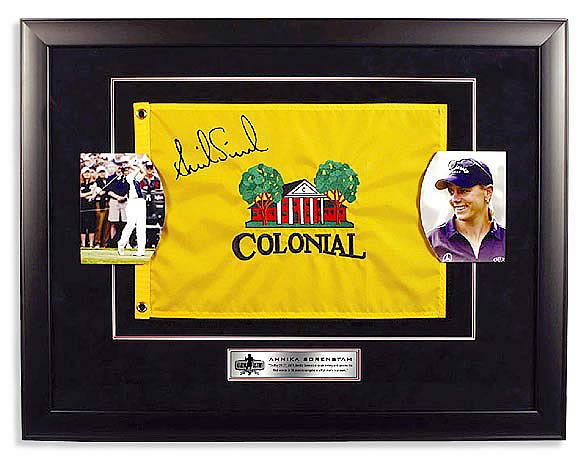
Golf Channel documentary - 10th anniversary of Annika in PGA event

To mark the 10th anniversary of Annika Sorenstam playing in a men's PGA Tour event, Golf Channel is airing an original documentary to chronicle her appearance at the Colonial. The 30-minute program Go Annika will debut on Wed 5/22 at 9 pm ET with multiple replays scheduled. While Annika was not the first woman to complete in a PGA event, she was the first in 58 years and the first one to be televised in doing so.

The Thu/Fri rounds of that 2003 tournament were televised by the USA Network which showed every one of Sorenstam's shots. USA Network actually came on the air at 9:58 am ET that Thursday to start with her opening drive. The TV crew on USA Network for the event included Bill Macatee, Peter Kostis, and Patty Sheehan. Annika's participation in the tournament produced record ratings on USA Network for a PGA Tour event.


Despite missing the cut, Annika also figured prominently in the CBS weekend coverage which added an hour of Saturday coverage to spotlight her performance. David Feherty who was also on the telecast team that weekend is among the interview subjects for the documentary.

The Golf Channel site has a preview clip.

Here is an interesting look back at previews of the TV coverage from 2003 newspapers: Richard Sandomir in the NY Times and Rudy Martzke in USA Today. And here is how Larry Stewart of the LA Times reviewed the opening round TV coverage.

Tuesday, May 14, 2013

The NBA on CBS late night and tape delay playoff era

It seems unthinkable now, but from 1979-1981, CBS actually televised 9 of the 17 NBA Finals games in the 11:30 pm ET timeslot with 6 of those games airing on tape delay. For the surrounding years, CBS made frequent use of late night telecasts during the playoffs. And even for these late night games which CBS televised live in the east, most CBS affiliates in the west aired these games on tape delay at 11:30 pm PT.

Here is a closer look at this low point in NBA television history.

Background

For the first 3 seasons of its TV contract with the NBA, CBS televised all weeknight Finals games in prime time and aired some earlier round games in prime time as well. But starting in 1977, with NBA ratings on the decline, CBS moved all of its weeknight pre-Finals telecasts to 11:30 pm ET. CBS aired these live which of course meant these telecasts only involved teams from the Western Conference. Most of these late night games were on Fridays.

Tape delayed and late night NBA Finals

In 1979, CBS continued to use the late night timeslot for live playoff games. But the network provided a real slap in the face to NBA fans by televising Sonics-Bullets Finals game 2 from Landover on a 3-hour tape delay at 11:30 pm ET. So the first-ever CBS tape delay playoff telecast was a Finals game. CBS televised game 4 from Seattle live in the east at 11:30 pm ET, but on tape delay in much of the west.

The 1980 Lakers-76ers Finals featured popular teams and top stars (Julius Erving, Kareem Abdul-Jabbar, and Magic Johnson). Yet CBS aired games 2 and 5 from Los Angeles live in the east at 11:30 pm ET, but again on tape delay in most of the west. And infamously, CBS televised the deciding game 6 on a 2.5 hour tape delay.

Rock bottom

The worst season for tape delays was 1981. That year, CBS again intended to show many live late night games from the west coast. However, the Lakers and Trail Blazers were upset in the mini-series and the top-seeded Suns were eliminated in the next round. During the 1981 playoffs, CBS televised a whopping 17 games at 11:30 pm ET, but due to the lack of west coast game site, only three of these games aired live. On 4/29, CBS actually provided regional coverage of two games on tape delay (the first and last time they would do this). The Celtics-Rockets Finals featured 4 games on tape delay including the clinching contest for the second straight year. CBS aired games 1 and 2 on a 4-hour delay.

During the tape delayed telecasts, CBS would periodically stick a Recorded Earlier graphic on the screen. In some cases, the CBS affiliate in one or both of the participating markets would televise the game live.


The final years of late night telecasts

In 1982, the NBA shifted the season a few weeks later to move the Finals away from the May TV sweeps period and CBS resumed showing Finals games live in prime time. However, CBS continued showing many earlier round NBA playoff games at 11:30 pm ET. The last tape delay telecast occurred during the 1986 conference finals. In 1987, CBS aired game 6 of the Eastern Conference finals in prime time which marked the first non-Finals prime time NBA playoffs telecast on CBS since 1976. The last time CBS used the 11:30 pm timeslot was in 1988.

Lowlights from the tape delay era
  • For the first week of the 1981 conference finals, CBS featured the Houston-Kansas City series (both teams finished under .500!!) over the Boston-Philadelphia series (brand names which tied for the best record in the league). The reason for this bizarre programming decision? CBS preferred the shorter lag time between tipoff and the start of the late night tape delay telecast for the Western Conference series.
  • On the halftime show for the tape delayed 1981 Boston-Philadelphia game 5 (with the 76ers leading the series 3-1), host Brent Musburger promoted the CBS telecast for game 6 of that series on Friday without any "if necessary" qualifiers thereby tipping off viewers that the Celtics would win game 5. Musburger was doing that halftime show live and therefore knew the result.
  • During game 5 the 1981 NBA Finals, CBS analyst Rick Barry uttered the controversial "watermelon grin" remark which aired unedited on the late night tape delay telecast.
  • In both 1980 and 1981, the NBA scheduled Finals games back-to-back on Sat and Sun afternoon rather than add yet another tape delay telecast to the mix.
  • In the early 1980s, when cable TV networks such as USA Network and ESPN carried many playoff games, CBS would annoyingly hold selected games for tape delay and prevent a live national cable telecast. For example, in 1982 USA carried game 5 of the Eastern Conference finals live while game 6 was relegated to late night tape delay on CBS.
  • On the 11 pm local news on CBS affiliates, the anchor for the sports segment would suggest that you turn away for a few minutes if you didn't want a "spoiler" for the upcoming tape delayed game. 

Summary of 11:30 pm ET NBA playoff telecasts on CBS

1977: 6 games (all live)
1978: 6 games (all live) - one night, CBS televised 2 of these regionally
1979: 8 games (7 live including 1 Finals game, 1 on tape delay which was in the Finals)
1980: 9 games (7 live including 2 Finals games, 2 on tape delay including 1 Finals game)
1981: 17 games (3 live, 14 on tape delay including 4 Finals games) - one night, CBS televised 2 tape delay games regionally
1982: 5 games (1 live, 4 on tape delay)
1983: 6 games (4 live, 2 on tape delay)
1984: 4 games (3 live, 1 on tape delay)
1985: 3 games (1 live, 2 on tape delay)
1986: 3 games (1 live, 2 on tape delay)
1987: 1 game (live)
1988: 1 game (live)

total: 69 games (43 live including 3 Finals games, 26 on tape delay including 6 Finals games)

Thursday, April 18, 2013

CBS issues error-filled press release on historic Masters TV announcers

Last week, CBS issued a press information guide on the Masters. That site contains a section on Masters history and one of the links points to an document purporting to list the year-by-year CBS-TV announcers for the Masters going back to 1956. Back in 2005, CBS had issued an earlier version of such an announcer listing. Some years ago, I compared my own independently performed research to the listings in the 2005 CBS press release and found numerous discrepancies.

The 2013 version contains a few changes from the previous one, but outside of adding the years since 2005, the updated release isn't all that different from the original.

I have no idea what research methods or sources CBS used to compile this list, but it contains so many obvious mistakes that one would be hard-pressed to take it seriously. What an embarrassing press release by CBS!

Here is a summary of the most blatant errors in the latest CBS announcer document:

  • The listings for 1975-1978 inexplicably do not include Vin Scully even though he was the lead CBS announcer on those telecasts. For proof, CBS could simply view the footage it re-aired from three of these tournaments on the Jim Nantz Remembers Augusta series which featured Scully covering the 18th hole each time.
  • Jack Whitaker was banned by Augusta after referring to the fans as a "mob" during the 1966 tournament and was not reinstated until 1972. Despite this well-documented fact, the CBS release incorrectly shows Whitaker working each of the interim years.
  • The listed announcers for 1967 are completely wrong. Due to an AFTRA strike, that telecast was handled by a set of CBS management personnel and a few Augusta National members, not the CBS golf talent.
  • For 1960, it incorrectly claims that Chris Schenkel was the 18th hole announcer with Jim McKay on 17 and does not list Art Wall. This directly contradicts the footage from the 1960 Masters telecast which CBS re-aired on the 2007 edition of Jim Nantz Remembers Augusta. That footage clearly had McKay on 18 and had Wall as an analyst. Schenkel didn't even appear on that special.
  • The listing for 1986 does not include Gary McCord who definitely worked the tournament that year (and was on hole 14). Of course, CBS (perhaps instructed by Augusta) went out of its way to edit out any audio or mention of McCord when it replayed footage from this tournament during the 2006 edition of Jim Nantz Remembers Augusta. The CBS release shows hole-by-hole assignments and doesn't list anyone for the 14th.
  • The CBS release lists Ray Scott from 1975-1978. Scott no longer worked for CBS at that time.
  • It lists Jay Randolph from 1969-1978. Randolph worked for NBC at that time.
  • It lists Frank Gifford from 1972-1978. Gifford worked for ABC at that time.
  • It lists McKay from 1962-1965. McKay worked for ABC at that time.
  • It lists Ed Ingles, Jim Kelly, and Nick Seitz for a few years. They never worked the Masters on TV, but instead called the event on CBS radio.

Tuesday, April 9, 2013

History of the Masters golf tournament on TV (1956-present)

The Masters golf tournament has been a longtime spring staple on the sports TV calendar. The Augusta National Golf Club and network partner CBS have a unique relationship. CBS operates on one-year contracts and pays far less than market value for the rights. In return, Augusta National insists on approval of all announcers and dictates terms of the coverage (no mention of prize money, plenty of references to "patrons" and "second cut", no promotions for other TV programs, etc.). From the beginning, the tournament has been presented with minimal commercial interruption (just 4 minutes per hour).

Augusta National has always limited the amount of coverage by its TV partners. While it has allowed the number of TV hours to increase in recent years, it still lags significantly behind the other golf majors in this area.

Here is a look at how the coverage has evolved over time beginning with the first televised Masters in 1956. All listings of hours refer to scheduled TV coverage. Note: For detailed TV schedules and announcers by year, see my complete research on Masters TV history over at 506sports (free registration required to view).

<EDITED on 4/18/2019 to bring this up to date as of the 2019 tournament>  

Chronology of Masters TV coverage

1956 - CBS provided a half hour of coverage on Friday with one hour each on Saturday and Sunday. Chris Schenkel and Bud Palmer manned the microphones. CBS only covered holes 15-18 with all of its cameras stationary and most of them pointed at the greens.

1957 - Jim McKay became the lead announcer.

1958 - CBS expanded its Sunday coverage to 1.5 hours and eliminated the Friday coverage.

1959 - Frank Chirkinian produced his first Masters. CBS added cameras to cover more fairways and tees.

1961 - The tournament concluded on Monday due to weekend rain and CBS added an hour of Monday late afternoon coverage.

1962 - Schenkel resumed the lead broadcast role as McKay had moved to ABC. The Masters had an 18-hole playoff on Monday and CBS provided one hour of coverage.

1965 - Jack Whitaker took over the lead announcer role.

1966 - The Masters was televised in color for the first time. An 18-hole playoff was needed and CBS televised the end of it on Monday afternoon. This was the year that Whitaker made an on-air comment referring to the gallery surrounding the 18th green as a "mob". For this, he was banned from the telecasts by Augusta National chairman Clifford Roberts for the next several years. Henry Longhurst called his first Masters for CBS.

1967 - A strike by the American Federation of Radio and Television Artists (AFTRA) impacted the coverage. With the regular CBS golf broadcasters honoring the strike, some CBS management personnel handled the telecast along with two top amateur players who were Augusta members.

1968 - Pat Summerall broadcast the Masters for the first time and anchored the coverage at hole 18. Frank Glieber also made his Masters TV debut.

1969
Ray Scott joined the CBS telecast crew. So did Frank Gifford who worked golf for CBS for a few years before moving to ABC.

1970 - Scott took over as the 18th hole announcer. The final 18-hole playoff took place this year and CBS added late Monday afternoon coverage for that.


1973 - CBS expanded to 2 hours on Sunday. CBS added late afternoon coverage on Monday after rain necessitated a Monday finish. Ben Wright joined the CBS crew for the first time.

1974 - This was the last year that Scott served as lead announcer.

1975 - Vin Scully worked his first Masters and assumed the 18th tower announcer role.
1977 - CBS expanded to 2 hours on Saturday.

1980 - CBS increased the Sunday coverage to 2.5 hours.

1982 - This year saw a major change as the USA Network provided Thursday and Friday coverage (2 hours live each day along with a prime time replay). This was the first ever cable coverage for one of the golf majors. The USA coverage used the CBS production crews and CBS announcers.

1983 - Summerall took over the 18th hole tower role as Scully had moved to NBC. Verne Lundquist made his debut on the Masters. So did Brent Musburger who was stationed in Butler Cabin for the first of 6 consecutive years. CBS increased the Saturday coverage to 2.5 hours and Sunday to 3 hours. Due to rain, the tournament did not finish on Sunday, so CBS added late afternoon Monday coverage.

1986 Gary McCord and Jim Nantz joined the CBS crew. Bob Carpenter hosted the USA coverage.

1988 - CBS shifted the Sunday TV window to end at 7 pm ET where it remains to this day.

1990 - Bill Macatee hosted the USA coverage and would do so for all subsequent years that USA had the TV rights.

1994 - McCord made the infamous on-air "bikini wax" reference while describing the speed of the Augusta greens and remarked that mounds behind the 17th green resembled "body bags". These comments did not go over well with Augusta officials and despite still being a member of the CBS golf team, McCord has not worked the Masters since. That was also the last Masters tournament (and final CBS assignment of any kind) for Summerall who moved to Fox.

1995 - USA expanded the Thursday/Friday coverage to 2.5 hours each day. Nantz took over the lead announcer role.

1996 - Chirkinian produced the CBS telecast for the final time.

1997David Feherty called his first Masters on CBS as did Peter Oosterhuis.

2000Dick Enberg started a 7-year run of hosting the Masters from Butler Cabin. The Masters was televised live in HDTV for the first time.

2002 - Another major milestone took place this year as CBS increased the Sunday coverage to 4.5 hours and showed the leaders for all 18 holes. CBS had wanted to do this for a number of years, but tournament officials had always denied these requests in the past. This was also the last Masters in the TV booth for longtime lead analyst Ken Venturi.

2003Lanny Wadkins became the lead analyst and CBS expanded the Saturday coverage to 3.5 hours ending at 7 pm ET. The SD and HD productions of the event were unified. In the wake of the controversy over the Martha Burk protest regarding Augusta membership practices, the Masters chose to drop its sponsors. Both CBS and USA televised the event commercial-free. The same was true in 2004.

2005 - USA increased the Thursday/Friday coverage to 3 hours.

2006 - CBS added a one-hour special Jim Nantz Remembers Augusta which led into the Sunday coverage. That show looked back on the 1986 Masters using original CBS footage. This series has become an annual Masters Sunday tradition featuring vintage CBS telecast clips being rebroadcast for the first time.

2007Nick Faldo took over as CBS lead analyst joining Nantz in the 18th hole tower.

2008 - ESPN took over the Thursday/Friday coverage with Mike Tirico anchoring the action.

2009 - ESPN increased the Thursday/Friday coverage to 3.5 hours each day. CBS expanded the Sunday coverage to 5 hours.

2011 - ESPN expanded the Thursday/Friday coverage to 4.5 hours each day.

2013 - CBS increased the Saturday coverage to 4 hours. For both of the weekend rounds, CBS Sports Network aired a same-day prime time replay of the CBS network coverage.

2016 - Dottie Pepper became the first female TV announcer on the Masters.

2017 - Scott Van Pelt took over as the anchor for the ESPN coverage.

2019 - Due to a forecast for late afternoon storms, the Masters moved the Sunday tee times to the morning and sent the players out in threesomes. CBS televised the final round live starting at 9 am ET and re-aired much of that coverage at 3 pm.

Total scheduled live TV time for the Masters by year

1956-1972: 2.5 hours
1973-1976: 3.5 hours
1977-1979: 4 hours
1980-1981: 4.5 hours
1982:           8.5 hours (4 on USA, 4.5 on CBS)
1983-1994: 9.5 hours (4 on USA, 5.5 on CBS)
1995-1996: 10.5 hours (5 on USA, 5.5 on CBS)
1997-2001: 11 hours (5 on USA, 6 on CBS)
2002:           12.5 hours (5 on USA, 7.5 on CBS)
2003-2004: 13 hours (5 on USA, 8 on CBS)
2005-2007: 14 hours (6 on USA, 8 on CBS)
2008:           14 hours (6 on ESPN, 8 on CBS)
2009-2010: 15.5 hours (7 on ESPN, 8.5 on CBS)
2011-2012: 17.5 hours (9 on ESPN, 8.5 on CBS)
2013-2019: 18 hours (9 on ESPN, 9 on CBS)

Wednesday, April 3, 2013

Error in ESPN 30-for-30 short on 1972 Olympic basketball

I highly recommend the recent ESPN 30-for-30 digital short Silver Reunion which includes all 12 members of the 1972 USA Olympic Basketball team. The episode focuses on the continuing refusal by the players to accept silver medals after the controversial conclusion to the gold medal game. Unfortunately, this otherwise excellent documentary contains an inaccuracy.

At the 2:02 mark, the film displays a graphic which incorrectly states that the 1972 Olympic basketball games were played without a shot clock. Right after this, Doug Collins comments on the late game situation and perpetuates this myth which he has repeatedly done over the years.

The Olympics have always been played under international (FIBA) rules. FIBA introduced a 30-second shot clock in 1956 and that rule was indeed in effect for the 1972 games. The reason the USSR didn't try to run out the clock entirely on that possession was to avoid a shot clock violation. The 30-second clock also explains why the USA didn't attempt to foul a Soviet player as time was running out.

In September, Ken Pomeroy wrote an intriguing retrospective on 40th anniversary of this game where he also pointed out the shot clock rule, the faulty memory of Collins, and the staggering fact that announcers Frank Gifford and Bill Russell never once mentioned the shot clock during the entire ABC telecast. Perhaps that omission contributes as much to this longstanding myth as anything.


Tuesday, March 26, 2013

The first NBC prime time NCAA basketball title game

In 1973, NBC televised the NCAA championship game on Monday night after airing it on Saturday afternoon the previous four years. The success of Monday Night Football on ABC prompted NBC to move the basketball title game to prime time where it has remained ever since. That 3/26/1973 contest featured Bill Walton scoring 44 points and hitting 21 of 22 shots as UCLA defeated Memphis State to win its 7th consecutive championship. The telecast started at 9 pm ET with Curt Gowdy and Tom Hawkins calling the game for NBC.


Monday, March 18, 2013

TV coverage history of the NCAA Tournament (1969-present)

Last year, I compiled a 3-part historical summary of the TV coverage of the NCAA tournament from 1969 to the present. I recently made some updates and this week is an appropriate time to post the revised version.

Wednesday, March 6, 2013

Opening day of the USFL on ABC in 1983

In 1983, the United States Football League, equipped with TV contracts from both ABC and ESPN, launched a springtime pro football venture. The 12-team league kicked off an 18-game regular season schedule. Chet Simmons, former president of NBC Sports, was the league's first commissioner.

Unlike the NFL, the USFL did not blackout local TV for games which did not sell out. In an interesting twist, the USFL wanted ABC to make its instant replay footage available for referees to use on controversial calls, but the network declined.

Opening day was Sunday 3/6/1983, just five weeks after the NFL had staged its Super Bowl. ABC provided regional coverage of three games that afternoon at 3 pm ET along with a studio show hosted by Frank Gifford. Here was the ABC lineup with announcers:

  • New Jersey Generals at Los Angeles Express (Keith Jackson, Lynn Swann)
  • Chicago Blitz at Washington Federals (Jim Lampley, Lee Corso)
  • Philadelphia Stars at Denver Gold (Bill Flemming, Ron Mix)
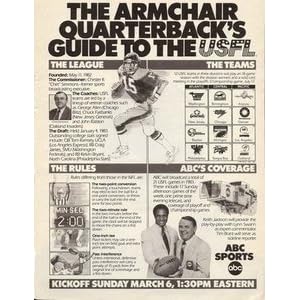
1983 USFL on ABC Promotional Advertisement Page Lynn Swann Keith Jackson
This ABC Sports promotional ad lists an opening day start time of 1:30 pm ET. Originally, ABC had planned to feature the Chicago-Washington game in that time slot and highlight the story line of Blitz coach (and former Redskins coach) George Allen making a return visit to the national capitol. But after the New Jersey Generals signed Herschel Walker on 2/23, ABC switched gears to instead showcase the Generals game in Los Angeles. The network shifted the regional telecast window later to accommodate the west coast site.

The first afternoon produced surprisingly strong ratings, but mediocre reviews for the TV coverage. During an update segment, Gifford announced the wrong team winning the Tampa Bay-Boston game.

ESPN opened its schedule the following night with Jim Simpson and Paul Maguire in the booth for the Michigan Panthers at Birmingham Stallions.

ABC carried Sunday afternoon games (usually at 1:30 pm ET) with a national telecast some weeks and regional coverage on others. Jackson and Swann were the #1 announcers. On Father's Day weekend, ABC was covering the US Open golf tournament. So the network televised a USFL game on Friday 6/17 at 9 pm ET, but that experiment produced very poor ratings.

ESPN televised Monday night games with Simpson and Maguire and also aired Saturday night games with Tom Kelly and Don Heinrich on the call.

The 1983 USFL season also marked the return of Curt Gowdy to a pro football TV booth. Here is Gowdy calling a regional ABC game from Boston.

While TV ratings dwindled as the season progressed, the season-long ABC numbers exceeded original projections. However, paid attendance was sluggish and ABC would try to carefully plan its camera shots to avoid showing backgrounds of empty seats.

The league hyped Herschel Walker and ABC tended to feature the Generals early in the season, but the New Jersey squad flopped on the field, finishing 6-12.

Here are clips from the three opening day ABC games with sparse crowds evident from the first two stills):


Monday, February 25, 2013

First network TV game for Larry Bird (2/25/1979)

Indiana State began the 1978-79 college basketball season unranked and did not appear on the original NBC TV schedule. But as the Sycamores remained unbeaten and star player Larry Bird emerged as the consensus national player of the year, attention started increasing on the team and its talented forward. Eventually, NBC decided to add a late-season Indiana State game to the schedule so it could showcase Bird before the NCAA tournament.

Many fans were at least aware of Bird. The Boston Celtics selected him in the first round of 1978 NBA draft, but he still had eligibility left and returned to school for his senior season. Sports Illustrated put Bird on the cover of its college hoop preview his junior year and profiled the team in an article early in 1979. But the sport received relatively limited coverage in the pre-ESPN era and Bird's teams had never qualified for the NCAA tournament, so most fans had still not seen him play.

NBC sent Jim Simpson and Al McGuire to Terre Haute to call the Sunday 2/25/1979 contest against Wichita State. And Bird put on a brilliant 49 point performance as Indiana State went to 26-0.


Despite the NBC coverage, not all parts of the nation got a chance to see Bird that day. For one thing, NBC did a regional telecast of a South Carolina game in the same timeslot (although the network did send the Indiana State game to most of the country). Also, some NBC affiliates pre-empted the network games for local programming.

Earlier in the season, Indiana State had become the focus of an on-air debate between McGuire and co-analyst Billy Packer. McGuire believed the undefeated Sycamores deserved to move up to #1 in the polls while Packer was rather vocal in his disagreement. This drew such ire among Indiana State fans that Packer actually received death threats. NBC played it safe and avoided assigning him to the 2/25 Indiana State game. Packer instead worked the game in Louisville which opened the NBC doubleheader that afternoon.

Indiana State ascended to #1 in the polls the next day and backed up the ranking by advancing all the way to the national championship game. NBC did send Packer (with Simpson) to call the Indiana State games for the first two weekends of the NCAA tournament. For the Final Four, Packer joined McGuire and Dick Enberg. The Bird vs. Magic championship game against Michigan State remains the highest rated college basketball game of all time.

Looking back at how relatively few schools NBC tended to select for its featured Sunday telecasts, it is quite interesting to note that NBC put its spotlight on a 1979 Missouri Valley regular season game! And while this remains the signature event in Sycamore regular season history, I find it ironic that the memorable moments section of the official Indiana State basketball record book lists the wrong date for this game.

Saturday, February 23, 2013

Season 3 of Feherty show on Golf Channel

The new season of the entertaining Feherty show debuts Monday 2/25 at 10 pm ET on Golf Channel with special guest Jack Nicklaus. The unique show hosted by CBS golf analyst David Feherty is well worth a season series recording on the DVR.

Other interview subjects for season 3 include Phil Mickelson, Colin Montgomerie, plus many with a connection to broadcasting including Jim Nantz, Paul Azinger, and Bob Knight. My favorite past episodes featured others who also had a TV background such as Ken VenturiJohnny Miller, and Lee Trevino.

Here is a preview of the Nicklaus show:


Monday, February 18, 2013

History of #1 analyst demotions

<UPDATE 6/9/2016: Added the demotions of Harold Reynolds and Tom Verducci as co-#1 Fox MLB analysts.>

<UPDATE 9/16/2013: Added the demotion of Clark Kellogg as lead CBS college basketball analyst.>

CBS analyst Phil Simms received many unfavorable reviews for his recent Super Bowl 47 broadcast performance and some critics have even suggested that CBS might (or should) demote him from the lead NFL analyst position.

phil simmsSimms has been the #1 NFL analyst at CBS for 15 seasons. He started there in 1998 working alongside Greg Gumbel and has been paired with Jim Nantz since 2004. For the three years prior to his CBS stint, he was one of two analysts on the #1 crew for NBC.

The post-Super Bowl speculation regarding CBS and Simms got me wondering about the historical frequency of such a move. So I decided to research cases where a TV network actually demoted its #1 analyst. Specifically, I looked at situations where CBS, NBC, ABC or Fox covered a sport using multiple announcer teams and I focused on the NFL, NBA, MLB, college basketball and college football.

For the purposes of this post, I am defining demotion as a case where the former "A" team analyst returns to the same network the following season on a lower tier broadcast crew.

Based on this research, no lead analyst with the longevity of Simms has ever been demoted to a lower tier crew on the same network. I only found 7 instances where a network demoted a #1 analyst who had been in that position for at least 5 years. In two of those cases, the "demoted" analyst actually moved into a play-by-play position. And in four of those cases, the network made the move to fit a newly hired broadcaster onto the "A" team.

Here is a closer look at those seven demotions ordered by longest tenure:

Tony Kubek (14 years as lead NBC MLB analyst)


Kubek had been the top analyst for the NBC baseball Game of the Week from 1969-1982 working first with Curt Gowdy and later with Joe Garagiola. In 1983, NBC hired Vin Scully as its lead play-by-play voice and Vin wanted no part of a three-man booth. So NBC decided to shift Garagiola into the lead analyst role alongside Scully and demoted Kubek to the "B" team where he worked with Bob Costas. Kubek remained in the #2 analyst role at NBC for 7 years. I believe this ranks as the most controversial lead analyst demotion of all time. On the plus side, Bob and Tony meshed so well together and I still consider them my favorite national baseball telecast tandem.

Bob Griese (12 years as lead ABC college football analyst)

ABC had used Griese as the top analyst for its NCAA games starting in 1987 where he worked with Keith Jackson. Griese remained in that role through the 1998 season. In 1999, ABC shuffled its broadcast crews and went without a true #1 team after Jackson switched to primarily covering west coast games. Griese remained on one of the crews which ABC treated as essentially co-#1. However, the network used Gary Danielson as the analyst for the BCS championship game that year.

Merlin Olsen (10 years as lead NBC NFL analyst)

Olsen had been in the #1 role at NBC from 1979-1988 working alongside Dick Enberg. In 1989, NBC brought in Bill Walsh as its new top analyst and demoted Olsen to the #2 slot. Merlin remained at NBC for only one season before taking an analyst position with CBS.

Bud Wilkinson (10 years as lead ABC college football analyst)

Wilkinson had served as the lead analyst on the ABC NCAA package from 1966 to 1975. He worked first with Chris Schenkel and later with Keith Jackson. In 1976, ABC demoted Wilkinson after it hired recently retired coach Ara Parseghian as lead analyst. Wilkinson remained with ABC for one season calling lower tier games.

Tom Brookshier (6.5 years as lead CBS NFL analyst)

Brookshier had been the lead CBS analyst since midway through the 1974 season when the network moved Pat Summerall into the top play-by-play role. That duo formed the #1 CBS team through the 1980 season. In 1981, CBS elevated John Madden into the lead analyst spot and shifted Brookshier to a play-by-play position on a lower tier crew. Brookshier remained with CBS for 6 more seasons after the demotion.

Don Drysdale (5 years as lead ABC MLB analyst)

Drysdale had been the top analyst on ABC Monday Night Baseball from 1978-1982. In 1983, ABC hired recently retired manager Earl Weaver as the new lead analyst. Drysdale stayed with ABC for 4 more seasons and became the play-by-play announcer on the "B" team.

Clark Kellogg (5 years as lead CBS college basketball analyst)

Kellogg was the #1 analyst on NCAA basketball for CBS 2008-09 through 2012-13. In September 2013, CBS promoted Greg Anthony to lead analyst. Kellogg became the lead studio analyst, but continued to serve as a game analyst on a lower tier crew.


Many cases involving a change to #1 analyst position featured an announcer retiring or moving to another network. Most of the long tenured lead analysts such as Billy Packer, Al McGuire, John Madden, and Tim McCarver were never demoted.

For completeness, here is a summary of the other cases when a network demoted its top analyst:

NFL

  Kyle Rote (3 years)
  • #1 for NBC from 1968-1970
  • demoted in 1971 for Al DeRogatis
  • remained with NBC in #2 analyst role for 3 years
  John Brodie (1 year)
  • #1 for NBC in 1977 
  • partially demoted in 1978 when NBC essentially used co-#1 crews of Brodie (paired with Curt Gowdy) and Merlin Olsen (paired with Dick Enberg)  
  • fully demoted in 1979 when NBC made Enberg and Olsen #1
  • remained with NBC in analyst role through 1984
  Bob Trumpy (3 years)
  • #1 for NBC from 1992-1994
  • demoted in 1995 for the duo of Paul Maguire and Phil Simms
  • remained with NBC in analyst role for 3 years

MLB

  Sandy Koufax (2 years)
  • co-#1 for NBC from 1967-1968 (Koufax and Pee Wee Reese were on a 3-man "A" crew)
  • demoted in 1969 for Tony Kubek
  • remained with NBC as "B" team analyst for 4 years
  Bob Uecker (2 years)
  • #1 for ABC from 1976-1977
  • demoted in 1978 for Don Drysdale
  • remained with ABC as "B" team analyst for 5 years
 Harold Reynolds and Tom Verducci (2 years)
  • co-#1 for Fox from 2014-2015
  • both demoted in 2016 for John Smoltz
  • each remained with Fox in a lower-tier game analyst role

NBA

  Tom Heinsohn (4 years)
  • #1 for CBS from 1983-84 to 1986-87
  • demoted in 1987-88 season for Billy Cunningham
  • remained with CBS in analyst role for 3 years
  Matt Guokas (4 years)
  • #1 for NBC from 1993-94 to 1996-97
  • demoted in 1997-98 season for Doug Collins and Isiah Thomas
  • remained with NBC in analyst role for 4 years
  Hubie Brown (2 years)
  • #1 for ABC from 2005-05 to 2005-06
  • demoted in 2006-07 for Mark Jackson and Jeff Van Gundy
  • has remained with ABC in #2 analyst role ever since

college football

  Ara Parseghian (1 year)
  • #1 for ABC in 1976
  • partially demoted in 1977 when ABC hired Frank Broyles - ABC essentially treated both Broyles and Parseghian as #1 analysts by alternating which of them was paired with Keith Jackson each telecast
  • fully demoted in 1981 when ABC made Broyles the sole #1 analyst 
  • remained with ABC as an analyst that year before moving to CBS in 1982
  Pat Haden (2 years)
  • #1 for CBS from 1982-1984
  • demoted in 1985 for Ara Parseghian
  • remained with CBS as an analyst for 5 more years (and was reinstated as the #1 analyst in 1987)

Monday, February 11, 2013

The NBC false claim - and opening night of 1980 Winter Olympics on ABC

NBC recently issued a press release claiming that its planned coverage of the 2014 Sochi Olympics would feature the first ever prime time event coverage before the opening ceremony. However, this NBC claim is false. In 1980, ABC opened its Winter Olympics coverage in prime time on Tues 2/12 from 9:30 - 11 pm ET, one night before the opening ceremony on Wed 2/13. (For completeness, ABC did the same thing in 1984 for the Sarajevo games.)

<Update 2/25/2013: ABC also provided prime time coverage the night before the opening ceremony in 1976 for the Innsbruck games (per a blog comment which I have verified).>

I watched the Olympics on ABC that opening Tuesday in 1980 and recall the oddity of televised event coverage prior to the opening ceremony. I also found multiple newspaper archives which supported my memory. Today, I was involved in some Twitter exchanges which helped proved this claim false - Fang's Bites provided a nice summary.

I also just found video proof which further supplements this research. This ABC promo clip runs down the ABC prime time schedules including the Olympics coverage for both 2/12 and 2/13:


The ABC coverage that first night included Al Michaels and Ken Dryden calling parts of the USA-Sweden hockey game from Lake Placid. That game took place 33 years ago tomorrow.

Monday, February 4, 2013

The 1975 Howard Cosell Saturday night variety show on ABC

In the fall of 1975, ABC and executive producer Roone Arledge took a bold step by creating a prime time variety series and installing sportscaster Howard Cosell as the host. With this show, ABC hoped to recapture the magic of the classic Ed Sullivan Show.

At the time, Cosell was one of the most recognizable personalities in the media industry. In 1970, ABC launched Monday Night Football and inserted Cosell into the broadcast booth. This package revolutionized the way TV networks treated prime time and Cosell was a key factor in its success. He was a polarizing figure who was never afraid to voice strong opinions. While many viewers despised the controversial Cosell, they would tune in to hear what Howard might have to say, and that worked well for Arledge.

Cosell had also branched into the entertainment arena via guest appearances on TV sitcoms such as The Odd Couple and in movies like Woody Allen's Bananas. He was frequently cast as himself in these roles.

Arledge felt that he could capitalize on the notoriety of Cosell and use the new variety show to boost ABC's entertainment ratings. This promotional clip provides insight into the ambitious expectations ABC had for the show. It also illustrates the pomposity of the one-and-only Cosell.


Cosell had many connections and believed this would enable the variety show to attract the top names in entertainment. Howard actually thought he could convince The Beatles to reunite on his opening show. He approached John Lennon with this idea, but Lennon turned him down.

ABC titled the 60-minute show Saturday Night Live with Howard Cosell and debuted it on 9/20/1975. ABC televised this series live (but showed it on tape delay on the west coast to fit it into the prime time schedule). It originated each Saturday night at 8 pm ET from the Ed Sullivan Theater in Manhattan.

Leading up to the premiere, ABC heavily promoted the show both on the network and with large ads in major newspapers. ABC specifically hyped the live entertainment angle as most other variety shows of the era were taped and edited for later airing. ABC would also cross-promote the variety show on the Monday NFL games and have Cosell plug the upcoming football game during the Saturday show.


ABC booked the shows with a mix of Hollywood stars, musicians, comedians, circus performers, and sports celebrities. The series utilized a regular comedy trio of Bill Murray, Brian Doyle-Murray, and Christopher Guest which ABC billed as the Prime Time Players.

Cosell was so nervous before the opening show that he wanted cue cards for backup despite the fact that he was legendary for doing his daily radio commentaries without notes or a script. That initial episode included Frank Sinatra, John Denver, Paul Anka, Shirley Bassey, Jimmy Connors, and the cast of The Wiz. It also featured two live remotes. one from London (just after 1 AM local time) with The Bay City Rollers rock band and another from Las Vegas of a Siegfried and Roy illusion act with lions. Media reviews for the debut were mediocre at best.

On the second show, Cosell conducted live interviews with Muhammad Ali and Joe Frazier a few days before their epic boxing match in Manila.

The live nature of the show led to some problems. On the 10/25 show, an Evel Knievel segment ran long so the producers determined that singing group Labelle would only have time for one song rather than the two they were promised. Upon learning this, the group refused to take the stage which forced Cosell to fill time roaming the audience.

Unfortunately for ABC, this series flopped in the ratings and received many negative reviews from newspaper critics. In the 10/9 Chicago Tribune, columnist Gary Deeb claimed to have information from "inside sources at ABC" that the cancellation of the show was a "foregone conclusion". At that point, ABC had only aired three episodes. On 11/26, just over two months into the run, ABC officially cancelled the show, but announced that it would stay on the air through mid-January. Overall, ABC produced 15 live episodes and three reruns over 18 weeks.

Don Mischer who directed the variety show recently did an interview looking back at his experience with Cosell and Arledge. He commented on the haphazard nature of booking live entertainment such as the night Arledge contacted Lionel Hampton about an hour before air time and slotted him into the show.

That same season, NBC launched a late night live series on 10/11/1975 called NBC's Saturday Night which aired at 11:30 pm ET. Unlike the ABC show, the NBC version proved successful and remains on TV. NBC termed their comedy team the Not Ready for Prime Time Players as a takeoff on the name ABC used. NBC would eventually adopt the name Saturday Night Live for its show.

On 4/13/1985, Cosell hosted an episode of Saturday Night Live on NBC. In the opening monologue, he reflected back on his ABC variety show in typical Cosell style.


Here is a chronology of Saturday Night Live with Howard Cosell on ABC with select guests by episode:

9/20/1975 - mentioned above
9/27 - John Wayne, Redd Foxx, Barbara Walters, Linda Ronstadt, Harry Blacksone Jr., The Eagles
10/4 - Alan King, Charo, Yogi Berra, Billy Martin, The Bay City Rollers
10/11 - Bill Cosby, Barry Manilow, Andy Griffith, Joe Frazier, Roberta Flack, The Rockettes
10/18 - Johnny Cash, Gabe Kaplan, Muhammad Ali, Evel Knievel, Ronee Blakley
10/25 - Soupy Sales (in Sea World), Evel Knievel, Kate Smith, Steve Landesberg, Chinese Acrobats of Taiwan
11/1 - Lee Majors, O.J. Simpson, George Burns, Walter Matthau, Joan Sutherland, Steve Landesberg, Rene Simard, The Rockettes
11/8 - Billy Crystal, Roy Clark, Ted Kennedy, Gwen Verdon, Chita Rivera, Esther Satterfield
11/15 - Andy Williams, Norm Crosby, Marilyn Michaels, Mark Wilson, Linda Hopkins
11/22 - Lionel Hampton, Tony Bennett, Lynn Anderson, John Byner, Ed Bluestone, Eunice Kennedy Shriver, Argentinian Gauchos
11/29 - Bob Hope, Rita Moreno, Doug Kershaw, Billy Eckstine
12/6 - Ben Vereen, Rodney Dangerfield, Olga Korbut, Billy Crystal, Roberta Peters
12/13 - Steve Allen, Robert Merrill, Esther Satterfield, Fred Travalena, Paul Anka, Chuck Mangione
12/20 - rerun
12/27 - rerun
1/3/1976 - rerun
1/10 - Milton Berle, Martin Mull, Charley Pride, Melissa Manchester, The Lockers
1/17 - Billy Crystal, Elayne Boozler, Ed Bluestone, The Bay City Rollers, The Movies

************

This post is part of a Classic TV Variety Show Blogathon. Check out the great content on the other participating classic TV blogs.


Monday, January 28, 2013

The infamous Tom Brookshier "Evidently" interview after Super Bowl 6

Here is a clip of the postgame interviews conducted by Pat Summerall and Tom Brookshier from the CBS telecast of Super Bowl 6 on 1/16/1972 after the Cowboys defeated the Dolphins 24-3.

This postgame show is best remembered for the extremely awkward interview that Brookshier conducted with Cowboys running back Duane Thomas who had not been talking to the media. The exchange starts at the 6:59 mark. After some rambling, Brookshier asked a rather inane question and Thomas uttered the classic one-word response of "Evidently". After a round of laughter, the clearly nervous Brookshier then redirected a different form of the question to Jim Brown before coming back to ask Thomas another question. Eventually Brown stepped in to speak on behalf of Thomas and essentially brought the interview to a conclusion. The entire sequence was quite bizarre and it haunted Brookshier for years.


The televised locker room interview scene looks quite amateurish compared to what one would see today. During the interviews, you can see many other media members milling around in close proximity. Multiple times you can see someone obstructing the camera shot of the interview. And Thomas and Brown both exit and walk right in front of Brookshier while he is still speaking. It was also interesting to hear both Summerall and Brookshier refer to the location as the "dressing room".

The 9:47 mark of the video has the original footage of the Ray Scott call of the touchdown run by Thomas. Scott and Summerall were the announcers on the CBS telecast.

Friday, January 18, 2013

The 1968 UCLA-Houston "Game of the Century"

This Sunday marks the 45th anniversary of the "Game of the Century" between UCLA and Houston at the Astrodome. That game on Saturday 1/20/1968 was the first prime time national telecast of a college basketball game. And it was almost certainly the most significant telecast in the history of the sport. To illustrate the state of college basketball on TV at the time, consider that the Final Four was not yet on network TV.

Houston coach Guy Lewis had the idea to schedule it at the Astrodome making this the first ever college hoop game played in a dome. The court was set up in the middle of the stadium meaning all fans were quite a distance from the action. The 4:00 minute mark on this documentary provides a great visual of the court position. The floor was imported from the Los Angeles Sports Arena. The event drew a record 52,693 fans.

Heading into the game, UCLA was ranked #1 and Houston #2. Both were unbeaten. UCLA featured Lew Alcindor and Lucius Allen, and was coached by John Wooden. Mike Warren (later of Hill Street Blues fame) also started for the Bruins. Houston was led by Elvin Hayes and Don Chaney. Behind 39 points by Hayes, the Cougars defeated the eventual national champion Bruins 71-69 and ended their 47-game winning streak.

ABC showed some interest in televising the game in the afternoon on Wide World of Sports. But Eddie Einhorn acquired the television rights and decided to syndicate the game in prime time on his TVS network. Einhorn lined up 150 stations in 49 states throughout the country. Some of these stations signed up on the day of the game.

Dick Enberg was the play-by-play announcer for the 9 pm ET telecast. At the time, Enberg was the UCLA broadcaster. The analyst was retired NBA star Bob Pettit. In his book Oh My!, Enberg labelled this game "the most important sports event I've ever called".

Interest in the game kept growing to the point that Einhorn was actually fielding phone calls while the game was in progress from companies wanting to buy TV ads. He handwrote ad scripts on the fly and handed them to Enberg to read on the air during timeouts.

Here is a clip of the surviving footage from the historic TVS telecast (end of 1st half and entire 2nd half). It also contains snippets from some of the commercials. The video quality is quite decent considering the time period.


The telecast of this landmark game increased interest in college basketball and helped make it more than a regional sport. It also led to some additional nationally syndicated college basketball games on TVS and eventually on the Chesley network which owned the ACC rights. By the next season, Enberg became the lead announcer for TVS and called a number of subsequent national games that Einhorn produced, many of which featured UCLA.

Monday, January 14, 2013

The 1973 ACC Super Sunday college basketball telecast

40 years ago today, one of the most significant events in college sports TV history took place - the first Super Sunday college basketball TV game. On Sunday 1/14/1973, the ACC and the regional Chesley network produced a national telecast of the NC State at Maryland game on the day of Super Bowl 7.

At the time, college basketball was primarily a regional sport and schools almost never played on Sundays. However, the ACC and TV rightsholder C.D. Chesley decided to schedule this matchup on Sunday, line up 145 stations throughout the country (with help from the Hughes Sports Network), and syndicate this game nationally.

The idea was to provide a sports viewing option to lead fans into the Super Bowl pregame programming. The basketball game started at noon ET so it would end well before the Dolphins and Redskins kicked off at 3:30 pm ETChesley originally considered televising this game nationally on Saturday 1/13, but believed he could clear more stations for a Sunday telecast.

The game spotlighted the top two teams in the ACC. Maryland was ranked #2 and featured Tom McMillen, Len Elmore, and John Lucas. NC State was ranked #3 and led by David Thompson and Tom Burleson. All five of these players would become first round NBA draft picks.

Ray Scott and Billy Packer were the announcers for this historic telecast. Even though Jim Thacker was the primary play-by-play announcer on the regional Chesley network, the ACC felt that the unique national stage for this game required a more recognized announcer such as Scott to be the lead voice. Scott of course was a high-profile NFL broadcaster who had called three Super Bowls for CBS. Chesley did include Thacker on the telecast for sideline features.

This game also put Packer in front of a nationwide audience for the first time. The first national network TV deal for the sport was still three years away, but this telecast helped position Packer for the analyst role on that package.

The event worked out perfectly for Chesley as NC State won a thrilling contest 87-85 behind 37 points from Thompson who burst onto the national scene that afternoon. An estimated 25 million TV viewers watched the game, exceeding Chesley's expectations.

A year later, the ACC and Chesley again televised a game nationally on Super Bowl Sunday between the same two schools. That Maryland at NC State game on 1/13/1974 started at 1 pm ET with Thacker and Packer on the call. Scott broadcast the Super Bowl on CBS later that day.

The ACC has a long history of Super Bowl Sunday telecasts and it all started in 1973.

Friday, January 4, 2013

NBCSN four-part series on Business of the NFL

NBC Sports Network is launching a four-part series on the Business of the NFL which chronicles the business decisions throughout its history which led to the explosive growth of the league. Part 1 of the Star Spangled Sundays series documents how the NFL used television to significantly boost the popularity of pro football and overtake baseball as the #1 sport in the United States. This initial 60-minute episode Rise of a Colossus debuts on Tues 1/8 at 10 pm ET with multiple replays scheduled.

The interview subjects include the following from a TV perspective: Bob Costas, Al Michaels, Don Ohlmeyer, David Hill, and Steve Bornstein.

The subsequent episodes in this series (subtitled Brand NFL, Labor Pains, and Super Sunday) will premiere each Tuesday in January on NBCSN.

Monday, December 31, 2012

Best of 2012 - Classic Sports TV and Media blog

I started the Classic Sports TV and Media blog on 12/30/2011, so yesterday marked the one-year anniversary of this site. For the benefit of newer readers, I decided to summarize some highlights from the first year of the blog. So here are my choices for the top 12 entries from this blog in 2012 (in chronological order of posting):
  1. recalling the day in 1982 when CBS pulled an analyst out of the stands to call an NCAA tournament game (with video)
  2. analyzing the myth about 3 consecutive buzzer beaters during the first weekend of the 1981 NCAA tournament
  3. a detailed three-part series on the history of the TV coverage of the NCAA tournament from 1969-present
  4. looking back at the Rick Barry "watermelon grin" comment during the 1981 NBA Finals (with video)
  5. remembering the classic New York Mets broadcast team of Lindsey Nelson, Bob Murphy, and Ralph Kiner (with video)
  6. a complete history of US TV coverage of the Ryder Cup from 1959-present
  7. a summary of how ABC and Keith Jackson handled conflicts between the baseball playoffs and college football
  8. recalling the magic of the ABC Monday Night Football Halftime Highlights narrated by Howard Cosell (with video)
  9. exploring the baffling myth about 1969 Alabama - Ole Miss being the first prime time college football regular season telecast
  10. introducing the first pairing of Pat Summerall and John Madden in 1979 (with video)
  11. providing a look at the first ESPN college basketball telecast in 1979 which was also the TV debut of Dick Vitale (with video)
  12. documenting the first game that Dick Enberg and Billy Packer called together in 1974
Thanks for reading and following. I have more content planned for 2013.